
Battery life claims decoded: how to compare mAh, hours and playtime tests before you order
Three numbers decide whether a playtime claim survives contact with a customer: the capacity inside the cell, the voltage that capacity sits at, and the condition set the hours were measured under. Most spec sheets give you the first, hide the second and omit the third. This is how a buyer reads all three, and what to demand in writing before the tooling is cut.
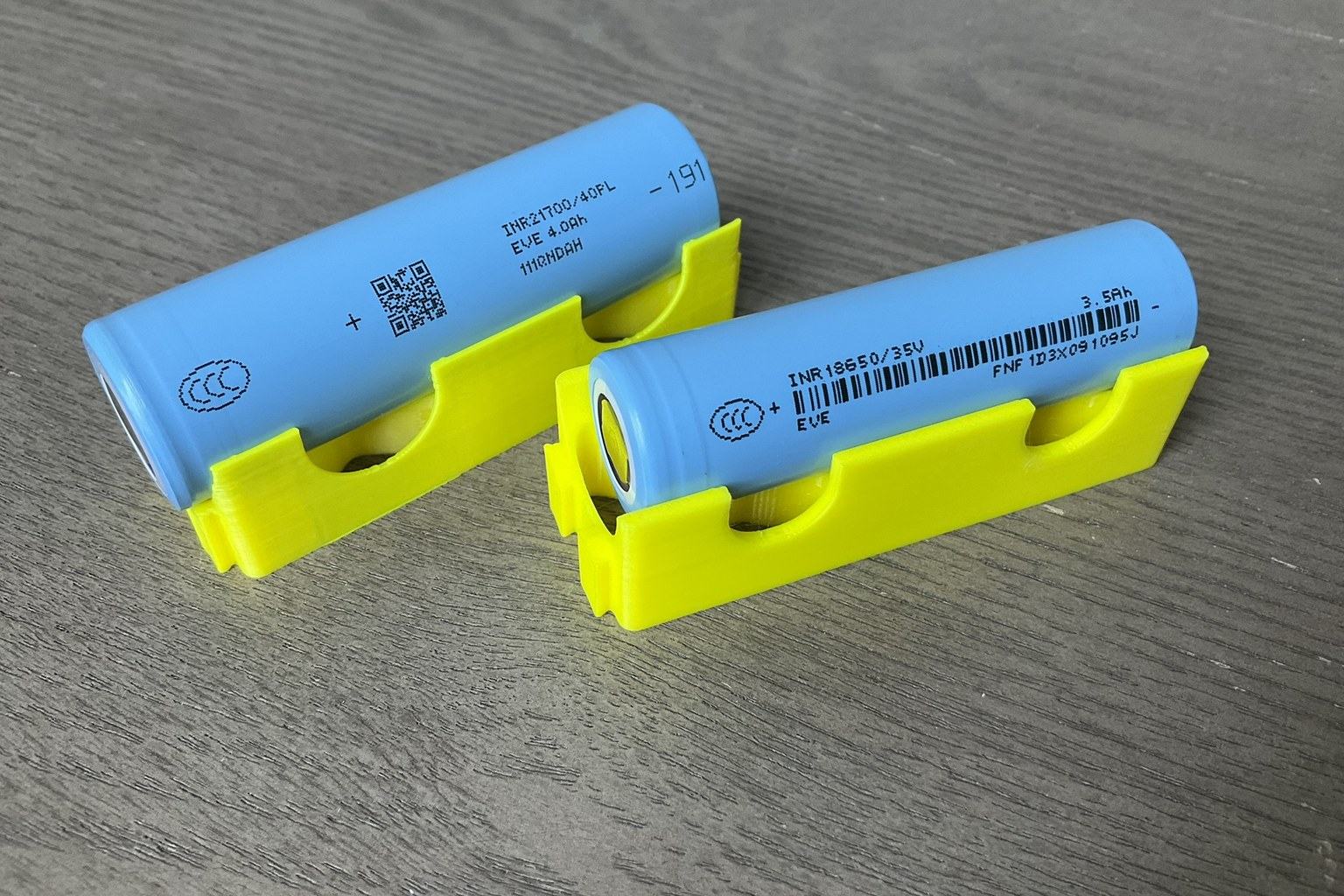
Header photo: Sevenethics / Wikimedia Commons, CC0
Almost no playtime claim is a lie. Nearly all of them are conditional. "Up to 8 hours" means eight hours under a condition set that is usually printed in small type at the bottom of the page, and sometimes not printed at all — a stated volume step, a stated codec, noise cancelling off, and a room at 25 °C. The useful question for a buyer is not "is this true" but "true under what", because the answer tells you whether your customer will get five hours or nine out of the same product. Everything else on the battery page follows from that.
We have watched this argument run in three directions at once: a brand insisting the sample "does 8 hours", the factory insisting the sample does, and a test house reporting 6 hours 20 minutes. Nobody was lying. The brand was repeating a number from a competitor's listing, the factory was reading a design calculation rather than a measurement, and the test house was running a discharge at a volume step nobody had specified.
Here is what separates those three numbers, and how to make sure the one you sign is the one your customer measures.
A playtime figure is a test condition wearing a number
Runtime is one division. The charge you can pull out of a cell, divided by the current the product draws while it plays. Both halves are measurable, and both halves are negotiable in a datasheet.
On the draw side, a modern TWS bud running AAC with the microphone idle sits somewhere around 5 to 10 mA. Switch on active noise cancelling and add roughly 15 to 25%. Wake the voice assistant, keep the companion app polling over BLE, or run LDAC instead of AAC, and the same bud can move from 7 mA to 12 mA — which is the difference between 8 hours and 5 hours on an identical cell. This is why two brands using the same cell and the same chipset can honestly publish wildly different numbers.
On the supply side, capacity is quoted at a discharge rate that has nothing to do with how your product actually drains it. That gap is where most of the arguments live, and it starts with a unit most people read wrong.
mAh is a volume, not a tank
Ampere-hours measure charge, not energy. To compare two batteries you have to multiply charge by voltage, which gives watt-hours:
Wh = mAh × V ÷ 1,000
A 3,000 mAh pack at 3.7 V holds 11.1 Wh. A 2,000 mAh pack at 7.4 V holds 14.8 Wh — fewer milliamp-hours, a third more energy. Anyone comparing those two by mAh alone will buy the smaller battery and believe it is bigger.
Inside one product category the mistake is usually harmless, because nearly every audio cell sits between 3.6 V and 3.85 V nominal. The two cells in the header photograph make the point quietly: the 18650 is marked 3.5 Ah and the 21700 beside it 4.0 Ah, both at 3.6 V, so 12.6 Wh against 14.4 Wh — 14% more energy in a can that is 5 mm wider and 5 mm taller. It stops being harmless in three places: when an earbud is compared against a speaker, when a high-voltage cell (3.85 V) is compared against a standard one (3.6 V) at the same mAh, and when a marketing team adds the case capacity to the bud capacity as if the two were the same battery. That last one is the most common, and it is the most expensive.
The case is a delivery system, not a second battery
Here is the arithmetic that a spec sheet will never show you, run on typical numbers for a mid-range TWS product. Each bud carries a 60 mAh cell at 3.7 V, so 2 × 60 mAh = 120 mAh for the pair, or 0.444 Wh. At 8 hours of playback that implies a draw of 7.5 mA per bud, which is right in the normal band for AAC with ANC off.
Now the case. Say it holds 500 mAh at 3.7 V, which is 1.85 Wh. It does not hand 500 mAh to the buds. It boosts 3.7 V up to 5 V, pushes it through pogo pins or a USB-C plug, and the bud bucks it back down to 4.2 V to charge its cell. Every one of those conversions loses something, and the loss is 15 to 25% in a well-designed case. At 80% transfer the case delivers 400 mAh, and a full pair-charge takes 120 mAh, so you get 3.3 recharges. Add the initial charge and you have 8 hours, then three top-ups, and the honest total lands near 32 hours — which is where the "up to 30 hours" claim comes from.
The trap is comparing that 30-hour figure between products. A competitor quoting "24 hours total" may have a longer per-charge runtime and a smaller case, or the same case and a worse bud. The two numbers are not additive, and the case figure on its own tells you almost nothing about either.
What "up to 8 hours" is measured at
Five conditions move a runtime figure by more than 10% each. If a supplier cannot state all five, the number is a design estimate, not a measurement.
| Condition | What it does to the number | What to ask for |
|---|---|---|
| Volume step | Each 3 dB of loudness doubles electrical power; full volume can halve runtime | The step as a percentage of maximum, and the SPL it produced |
| Codec | SBC and AAC are similar; LDAC and aptX Lossless cost 10 to 30% | Which codec was active, and the phone model used |
| Noise cancelling | ANC on adds 15 to 25% to the draw; transparency is similar | On, off, or transparency — stated, not implied |
| Ambient temperature | Capacity falls at 0 °C; ageing accelerates above 35 °C | The lab temperature, and one run at 0 °C for wearables |
| Test signal | Continuous pink noise draws more than music with quiet passages | The actual file or playlist used, and its level |
That last row is the one buyers never ask about, and the one that decides whether your number holds. Pink noise at a fixed level is the harshest honest test: it never stops. A pop playlist with quiet verses draws less on average because the driver and the amplifier are doing less work during those passages. Both tests are defensible. Only one of them matches what your customer will do, and it is the playlist.
Our own rule when we report a runtime to a brand is to quote the minimum of three runs on five units, not the average. The average flatters everyone and the minimum is what the returns desk sees.
Every cell label carries two capacities, and the smaller one is the promise
Look at any lithium-polymer pack built for a consumer device and you will find the capacity printed twice, in different words. The pack in the photograph below reads "minimal capacity: 1750 mAh (6.5 Wh)" near the top and "nominal capacity: 1830 mAh (6.8 Wh)" near the bottom. Two numbers, one cell, a gap of 4.4%.
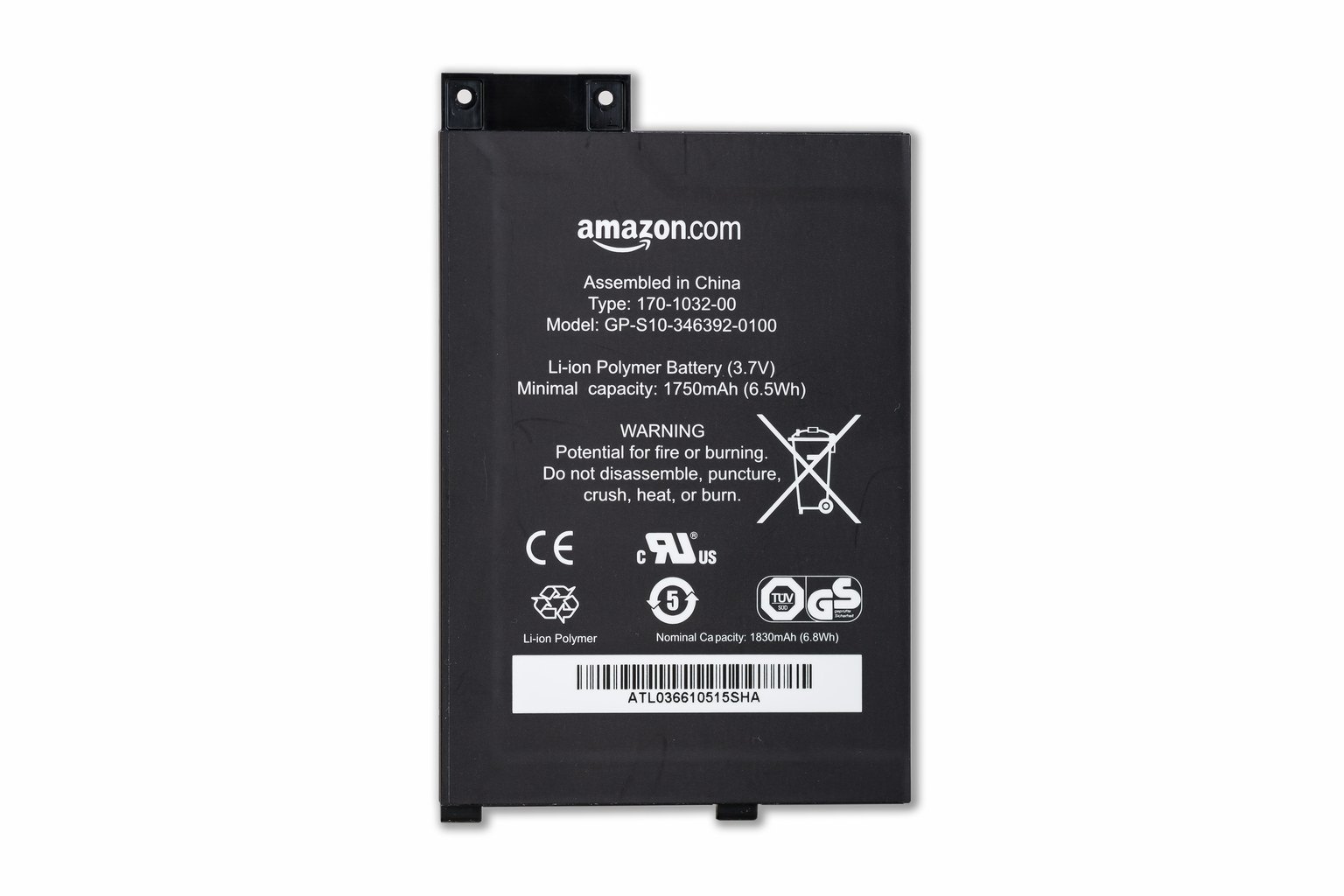
Nominal is the design target, measured on a fresh cell at 25 °C. Minimum is the floor the cell must clear after formation spread, ageing during storage and process variation. Both are real, both are honest, and they describe different obligations. When a Chinese factory writes "1830 mAh" in a quotation and "1750 mAh" on the part, it has not contradicted itself — but only one of those numbers will appear in a test report you can use in a dispute.
So write the minimum into the purchase order, with the test method attached: "minimum capacity not less than 1,750 mAh, measured at 0.2C, 25 °C, to 3.0 V cut-off, per IEC 61960". A specification without a method is a preference.
How a real capacity test is run
IEC 61960 is the standard for lithium-ion cells in portable applications, and the rated-capacity procedure is unglamorous in a way that makes it hard to fake. Charge at the specified current to 4.2 V, hold until the current falls to a twentieth of the charge rate, rest, then discharge at 0.2C to the cut-off voltage at 25 ± 2 °C. Run it three times, take the average, and the three results must agree within 2%. The measured capacity has to reach 100% of the rated value.
The 0.2C rate is the part that matters commercially. For a 60 mAh bud cell that is a 12 mA discharge, so one run takes about 5 hours. A factory testing at 1C — 60 mA — will finish in an hour and will report a number several percent lower, because high-rate discharge turns energy into heat inside the cell instead of delivering it. Neither number is wrong. They are measurements of different things, and the rate has to travel with the figure.
Three more numbers belong in the same conversation. Endurance: 500 full cycles to 80% of initial capacity is the usual consumer-grade floor, and a cell that reaches 80% at 300 cycles is not defective, just cheaper. Temperature: IEC 61960 expects at least 85% of rated capacity at 45 °C and at least 70% at 0 °C — a wearables battery that fails the cold test is a winter returns problem in Northern Europe and Canada. Self-discharge: a good cell loses under 5% a month at 25 °C, and the case sitting in a drawer for a season should not be flat when the customer opens it.
One detail that never makes it into a datasheet: the bud does not discharge the cell to 3.0 V. The amplifier browns out somewhere around 3.2 to 3.3 V, so the last 5 to 8% of the cell's capacity stays locked in the pack. The rated capacity is real, the usable capacity is smaller, and the difference is a design choice in the firmware's cut-off.
How to check a shipment without a laboratory
You do not need a cell lab to catch a short pack. You need five units, three cycles and a rule written down before the goods arrive.
Pull 5 pcs per lot, run three full charge and discharge cycles at 0.2C on a four-wire capacity tester, and compare the third cycle to the nameplate minimum. Accept at 95% or better, investigate between 90% and 95%, reject below 90%. Check the spread inside the lot too: if five cells from one batch vary by more than 3%, the sorting step was skipped, and mismatched cells in a pair is how you get one bud that dies twenty minutes before the other.
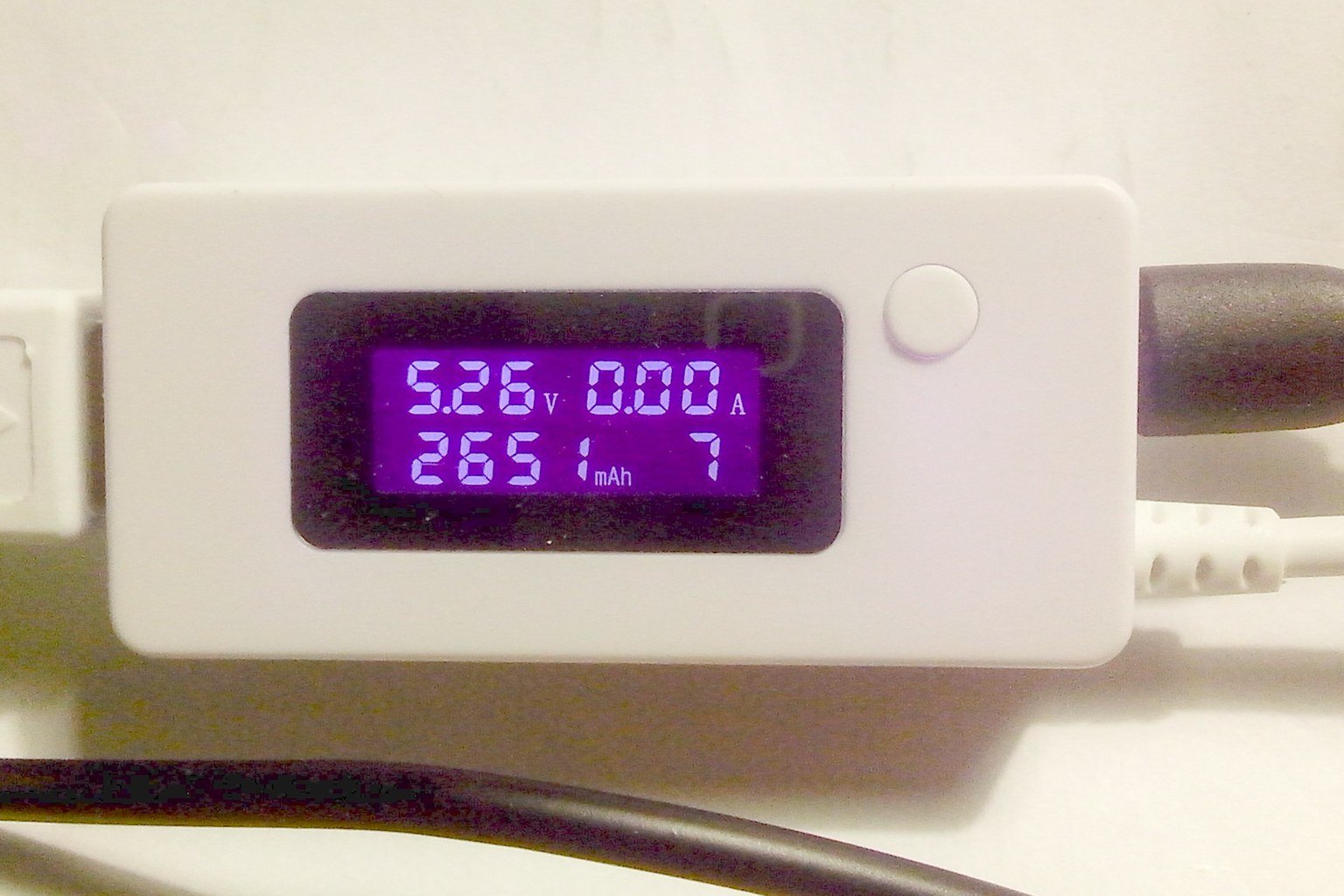
The USB power meter in the next photograph is the cheap alternative, and it is where careful buyers talk themselves into a false failure. The meter sits on the 5 V side of the charger, so it counts milliamp-hours at 5 V. This one reads 265 mAh at 5.26 V, which is 1.39 Wh delivered at the port. At 85% charging efficiency that is 1.18 Wh into the cell, and 1.18 Wh at 3.7 V is 320 mAh. The cell is not 55 mAh short of its 300 mAh rating; it is slightly over. Reading the meter's number as cell capacity understates it by roughly a fifth, every time.
Two more checks cost nothing. Measure the pack's internal resistance at the same state of charge every time; a small cell should land between 20 and 50 mΩ, and 90 mΩ on a fresh pack means a bad tab weld or a cheap separator. Then repeat one discharge at 0 °C in a domestic freezer, with the pack inside a sealed bag to keep condensation off. You are not looking for a lab number. You are looking for whether the capacity falls off a cliff, which is what happens when the electrolyte and the anode were chosen for cost rather than for cold weather.
Eight lines to put in the RFQ
This is the part that survives after the samples are gone. Put these in the RFQ, not in a follow-up email, and make the quotation invalid without them.
1. Cell definition. Chemistry, format, nominal voltage, and both capacities in mAh and Wh: nominal and minimum. Name the supplier's cell part number if the factory will disclose it.
2. Capacity test method. IEC 61960, 0.2C, 25 °C, stated cut-off, three runs averaged. Ask for the test report from the cell supplier, not a line in a datasheet.
3. Playtime conditions. Volume step as a percentage of maximum, codec, ANC state, ambient temperature, sample size, number of runs, and whether the figure quoted is the minimum or the average.
4. Case performance. Case capacity in mAh and Wh, measured transfer efficiency into the buds, and the number of full recharges it delivers — measured, not calculated.
5. Endurance. Capacity retention after 500 cycles at 25 °C, and the test's charge and discharge rates. Anything below 80% needs a price conversation, not a compromise.
6. Protection and gauging. Over-charge, over-discharge and over-current thresholds, NTC present or not, and whether the pack reports state of charge to the host or the bud estimates it from voltage.
7. Documents. UN38.3 test summary, MSDS, IEC 62133-2 report, and the battery marking artwork for the destination market. These are the four files that stop a shipment, not the four that describe it.
8. Shipping state of charge. Cells and packs shipped at 30% or below for air freight under Packing Instruction 965, and the evidence that the line actually measures it rather than assuming it.
If you only get one of the eight, take the third. A playtime claim without stated conditions is the single most common cause of a launch that ships and then gets reviewed badly — and unlike a tooling error, it cannot be fixed after the goods are on the water.
Where this becomes a design constraint in 2027
The numbers above are commercial. There is also a regulatory clock running, and it touches the enclosure rather than the cell.
Regulation (EU) 2023/1542, Article 11, applies from 18 February 2027. From that date, portable batteries in products placed on the EU market must be removable and replaceable by the end user — no proprietary tools, no solvents, no heat. The spare part has to remain available to independent repairers for five years after the last unit of that model is placed on the market, and software may not block a compatible replacement: part-pairing a battery to a serial number is specifically prohibited.
There are exemptions, and the exemptions are narrower than the market chatter suggests. Devices designed to operate primarily in wet environments — the kind that get splashed, rinsed or immersed — may have the battery replaced by an independent professional rather than the user. The Commission's guidance is explicit that an IP rating alone does not qualify a product: it looks at whether the wet environment is the primary operating environment and whether the device is washable or rinseable. A delegated act drafted in August 2026 proposes widening the list to cover sealed micro-wearables whose battery access would destroy water resistance, dust resistance or drop performance, or which are simply too small for a consumer to work on safely.
What that means at the drawing stage: a pair of TWS buds is small enough to argue for the sealed-wearable exemption, but the argument has to be documented, not assumed. Smart glasses and bands are in the same position. If your product cannot claim an exemption, the battery door, the adhesive choice and the service documentation all become part of the industrial design brief — and that is a change you want in the first tooling release, not in the revision after it. A battery door is cheap at the drawing stage and very expensive after the housing polish is signed off.
Our stance
Do not accept a playtime figure that has no condition set attached. It is not a specification, it is a slogan, and it will cost you a launch.
Do not compare milliamp-hours between a bud and a case, or between products built around different voltages. Convert to watt-hours first and the argument usually ends in one line.
Do not put the nominal capacity in the purchase order and then test against the minimum. Pick one, write it down with the method, and hold the factory to that number for the life of the order.
And do not treat a cheap cell as a cost saving. In a 60 mAh product the cell is a small share of the bill of materials and a large share of the returns. We would rather quote a pack that clears 500 cycles at 80% than win the order with one that reaches the same point at 300 — because the second product comes back in month fourteen, and the customer blames the brand, not the cell.
Have a battery claim you cannot verify?
We are a sourcing and OEM partner in Shenzhen, working across wireless audio, smart glasses and wearables. Send us the spec sheet and the playtime claim you were quoted and we will tell you which numbers are measured, which are calculated, and what the same product should look like at 1,000 pcs and 3,000 pcs.
See how we run an OEM project →