
Bone conduction vs air conduction: which fits your customers
Two completely different delivery paths, one shared cochlea — and a bass limit that no firmware update can fix. What each type can physically deliver, and how to choose before you commit to tooling.
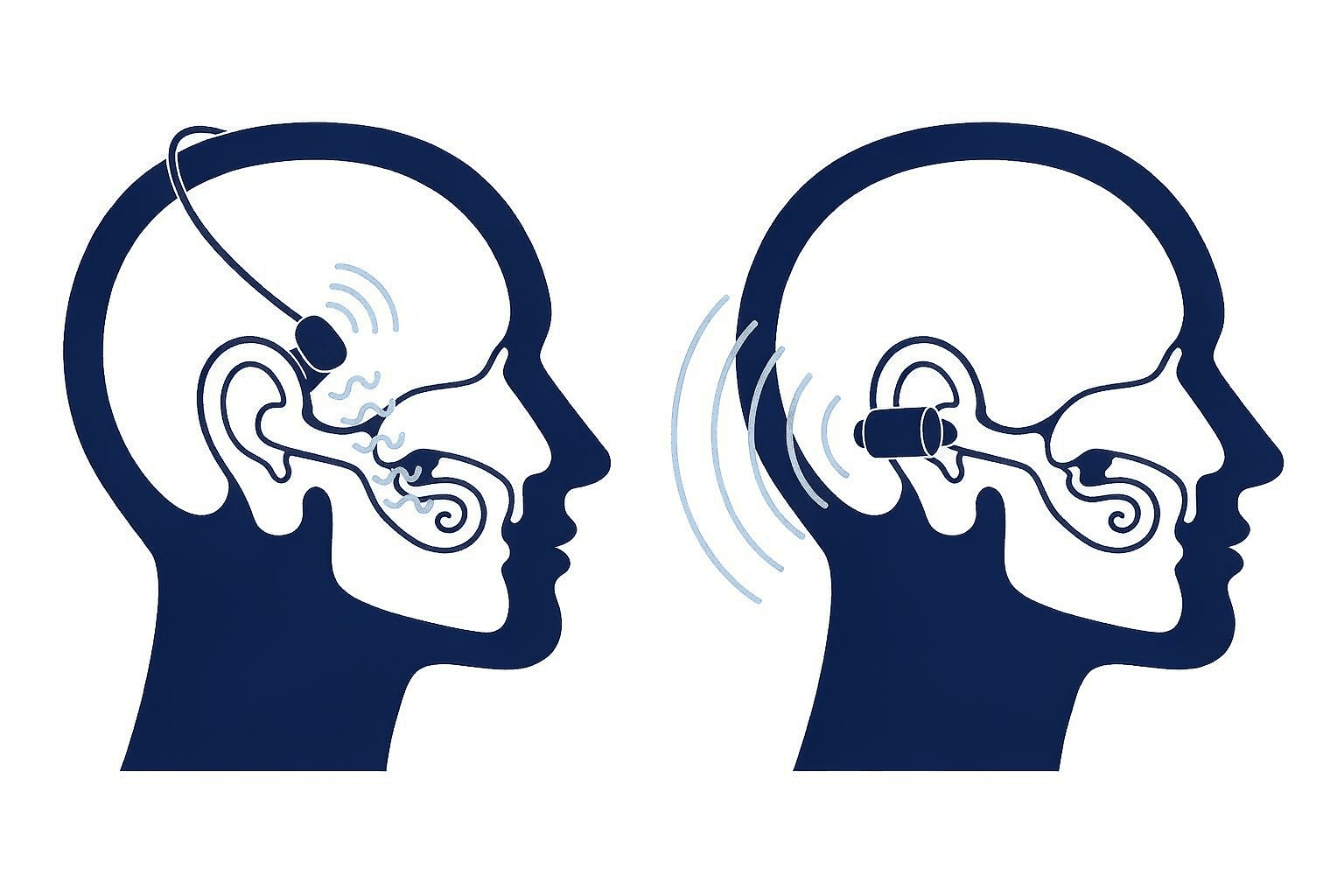
Bone conduction drives a transducer pressed against your skull and sends vibration straight to the inner ear, skipping the eardrum and the ear canal entirely. Air conduction pushes a diaphragm that moves air, and that air has to travel down a canal. The practical consequence is blunt: bone conduction keeps the ear open and survives water, but it has almost no usable output below roughly 100 Hz, and no tuning can change that. Air conduction gives you bass and isolation, but the moment you leave the ear open to keep the wearer aware, you lose the seal that bass depends on. So the choice is not "which sounds better". It is which compromise your customers will accept.
If your buyers are swimmers, industrial users, hearing-aid wearers or cyclists who need traffic awareness, bone conduction is the only format that solves their problem. If your buyers want music on a commute, open-ear air conduction or a sealed TWS will beat bone conduction on everything except awareness.
Two ways to reach the same nerve
Both formats end at the cochlea. They just take different roads to get there, and the road determines the spec sheet.
| Bone conduction | Air conduction (open-ear) | |
|---|---|---|
| What carries the sound | Mechanical vibration through skull bone and soft tissue | Air pressure waves down the ear canal |
| Ear canal | Fully open — nothing in or over it | Open, but a driver pod sits at or just outside the entrance |
| Usable low end | Rolls off below 100–150 Hz; bass is felt as rhythm, not heard as depth | Reaches much lower, but only a fraction of what a sealed tip delivers |
| Leakage to bystanders | Higher at the same perceived loudness — the pad radiates into the air as well as the bone | Lower, because the driver is aimed into the concha |
| Water and sweat | Easier to seal — there is no diaphragm and no air port to protect | Harder — the driver needs a grille, and the grille is a water path |
| Typical weight | 26–36 g for a behind-the-neck band | 8–14 g for a pair of clip pods with a case |
| What it is genuinely best at | Speech, navigation prompts, long-wear awareness, water sports | Music with some low end while keeping the ear open |
How the vibration actually reaches the cochlea
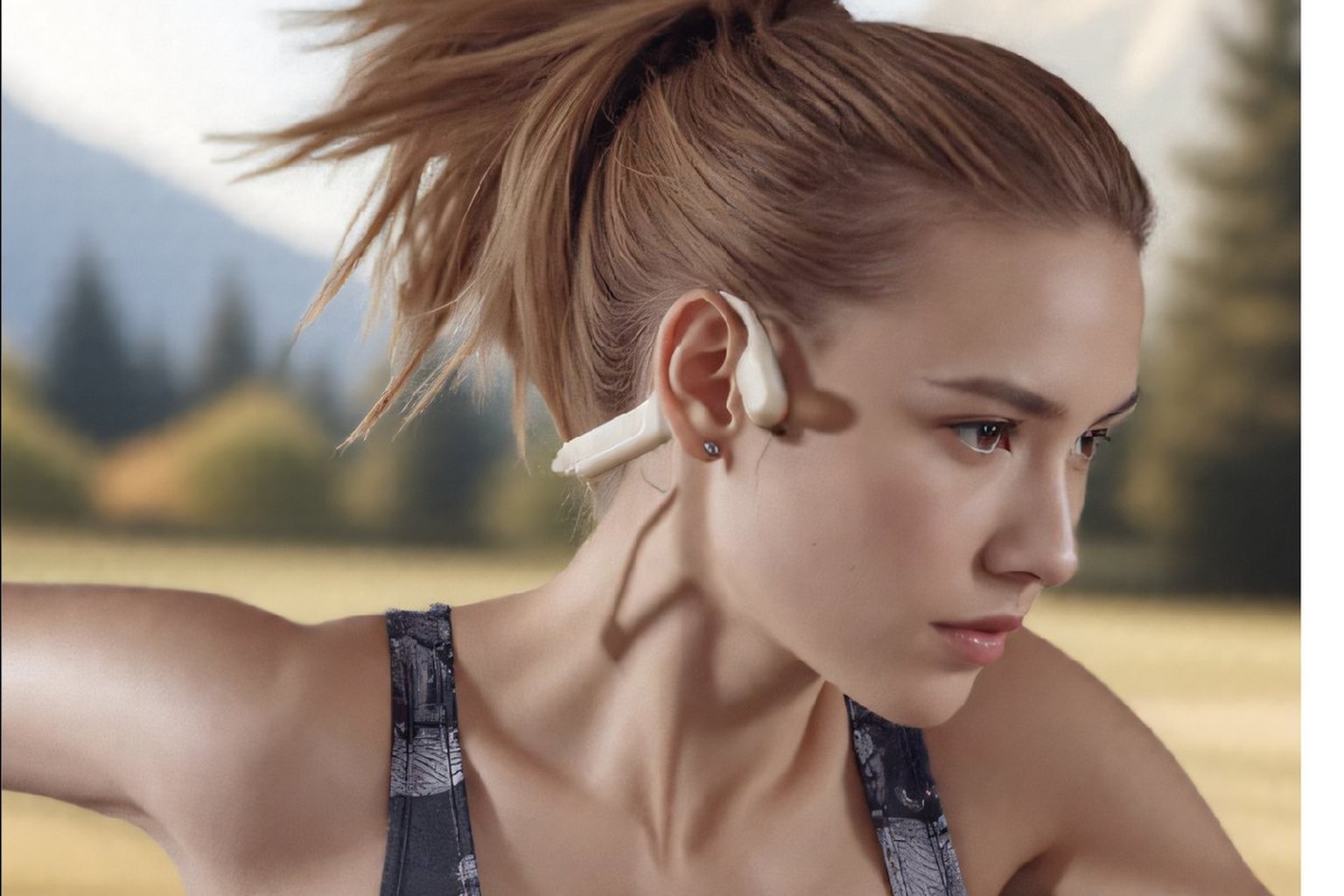
A bone conduction transducer is a small mass on a spring. An electromagnet drives the mass, the housing pushes against the cheekbone, and the oscillation travels through the temporal bone into the cochlea. Because the skin and the pad sit between the transducer and the bone, the energy has to cross a soft, lossy interface before it reaches anything rigid.
That interface is where the specification gets made or lost. Two units with identical drivers inside will measure differently if the pad material, the contact area and the clamp force differ. Every millimetre of movement changes the coupling, and coupling changes output.
Three consequences follow, and they explain most bone conduction complaints you will ever read in a review section.
Placement sensitivity. Move the pad 3 mm on the same head and the perceived level changes by several decibels — more than the difference between a good transducer and an average one. This is why two reviewers wearing the same unit report opposite results, and why one of them says the bass is "fine". They are describing their cheekbones, not the product.
Volume has a ceiling that is not thermal. Past roughly 80–85% of maximum amplitude, a cheap transducer starts to buzz — the vibration itself becomes audible as a rattle against the skin. Better drivers stay clean higher up, and this threshold is one of the few bone conduction specs that directly predicts whether customers will return the product.
Battery cost. Moving a mass takes more current than moving air at the same perceived loudness. A bone conduction unit with the same cell as an open-ear air unit usually posts a shorter playtime figure, and it is not a firmware problem.
Why an open-ear air design is not bone conduction
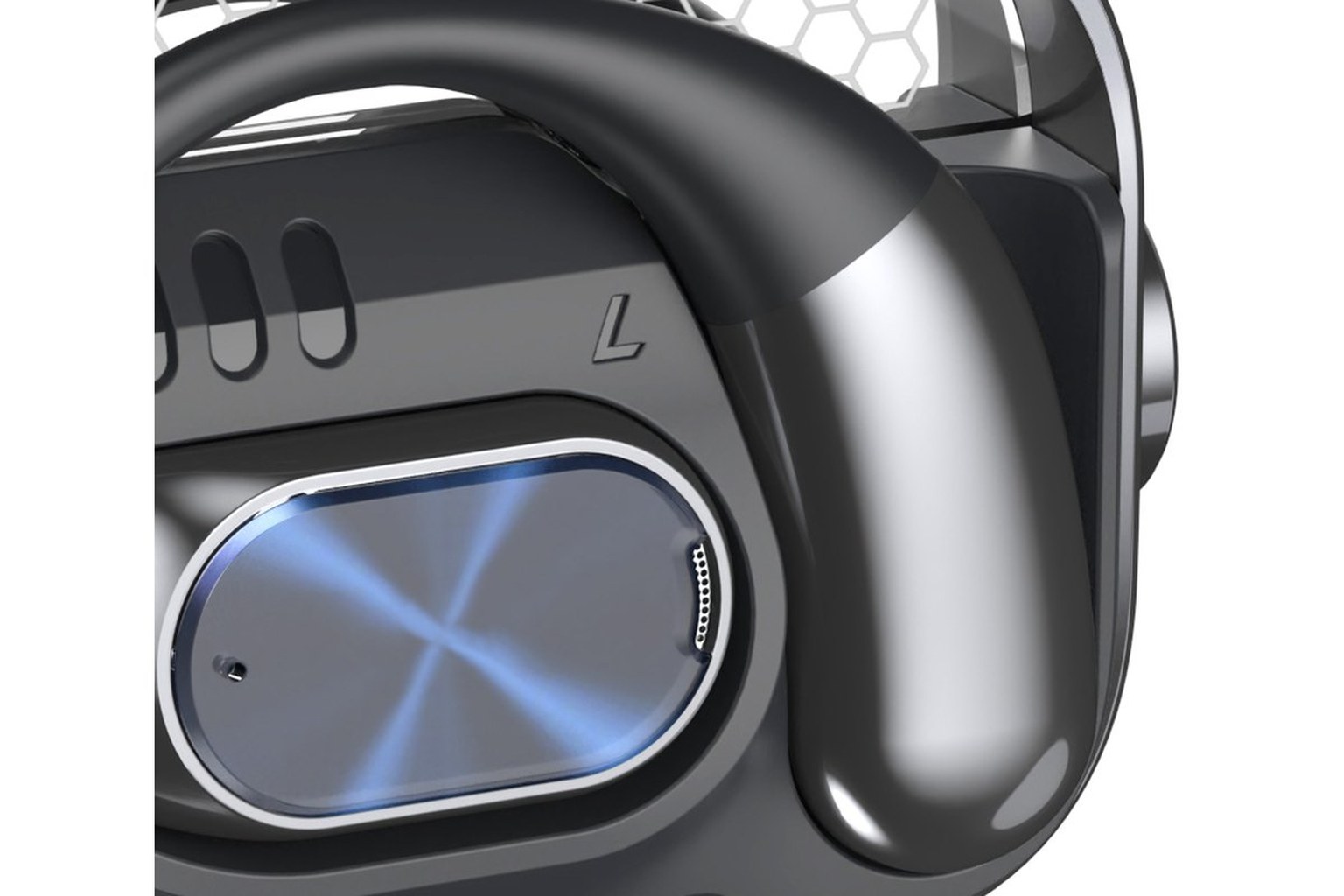
These two get sold as if they were the same category, and they are not. Open-ear air conduction uses a conventional diaphragm, typically 10–16 mm, mounted in a pod that hangs on a hook or clips to the pinna and fires toward the ear canal from a couple of centimetres away.
No seal means acoustic short-circuit: the low-frequency energy that leaves the front of the diaphragm wraps around and cancels against the back wave. Bass drops. What you keep is a lighter product, less leakage than bone conduction at the same loudness, and usually a better midrange because the driver is a normal driver working into normal air.
The asymmetry nobody puts on the datasheet
Here is the part that repays the reading time. Audiologists have measured bone conduction properly for decades. ANSI/ASA S3.6 and ISO 389-3 define reference equivalent threshold force levels for bone vibrators, expressed in dB relative to 1 µN, calibrated against an artificial mastoid under a static load of 4.9–5.9 N. The numbers are public. At 250 Hz the reference level at the mastoid is about 67 dB re 1 µN. At 1 kHz it is 42.5 dB.
Read those two figures again. To sit at the threshold of hearing, the same vibrator has to deliver roughly 24 dB more force at 250 Hz than at 1 kHz. That is the head itself refusing to pass low frequencies efficiently. It is a property of bone and tissue, not of any brand's driver, and it is why every honest bone conduction product is midrange-first.
Now the asymmetry: consumer bone conduction datasheets almost never quote anything in dB re 1 µN. They quote "20 Hz–20 kHz frequency response", which describes the electrical and mechanical range of the transducer assembly — not what actually arrives at the cochlea. Put both numbers in the same RFQ and you will find out very quickly which supplier has measured their product and which one has copied a speaker spec.
If you want a comparable bone conduction figure, ask for output measured on an artificial mastoid at a stated static load, at 250 Hz, 1 kHz and 4 kHz. Very few factories can supply it today. The ones that can are usually the ones already building for hearing-aid-adjacent customers.
The five numbers to put in the RFQ
| Ask for | Why it decides the order |
|---|---|
| Output in dB re 1 µN at 250 Hz, 1 kHz and 4 kHz, on an artificial mastoid at a stated clamp load | Turns a meaningless "20 Hz–20 kHz" line into three numbers you can compare across suppliers |
| Distortion threshold: the volume percentage at which transducer buzz becomes audible | Directly predicts one-star reviews. Anything under 75% is a problem for sports markets |
| Leakage measurement: A-weighted level at 30 cm with the unit at 60% volume | Office, library and open-plan markets live or die on this number, and it is never volunteered |
| IP rating with test method and duration (IEC 60529) | IPX5 is jets for at least 3 minutes; IPX7 is immersion at 1 m for 30 minutes. They are not tiers of the same thing |
| Placement tolerance: output variation across a 3 mm pad shift | Tells you how wide your market can be before fit complaints start, and whether a second pad size is needed |
Where each one loses
Bone conduction loses on bass, and it loses permanently. Pre-emphasis, harmonic synthesis and psychoacoustic bass enhancement all help the perception, and the good implementations are genuinely convincing on a podcast or a pop track. None of them put energy below 100 Hz into the cochlea. A kick drum arrives as a tap. If your customer's use case is critical listening, this is the wrong product and better marketing will only delay the returns.
Bone conduction also leaks. The pad radiates into the air as well as into the bone, so at around 60% volume a person standing 30 cm away can follow the audio. For swimming and trail running that is irrelevant. For an office or a long-haul flight seat, it is a real complaint, and it is worth writing into the user guide rather than discovering in reviews.
Open-ear air conduction loses the seal, and with it the isolation. That is the entire point of the format, so it is not a defect — but it does mean a buyer in a noisy city will perceive less bass than the bench curve suggests, because masking is doing half the work. It also puts the driver behind a grille, which makes water protection harder and more expensive than the equivalent on a bone conduction unit.
Neither one isolates. If your product story is "silence the commute", you are selling a sealed TWS or an ANC over-ear, and neither open format belongs in that conversation. Mixing the two messages in one product range is how brands end up with a catalogue that customers cannot navigate.

Choosing by customer, not by spec sheet
We have run both formats through the same partner lines for European and Australian sports brands, and the pattern is consistent enough to write down as a rule.
Choose bone conduction when the ear must stay open and wet. Swimming, trail and road running, cycling, industrial and warehouse environments, construction sites with hearing-protection rules, and users who wear hearing aids or have conductive hearing loss. Open-ear air conduction pods generally cannot take immersion, and an in-ear product in a swimming pool is a lost product.
Choose open-ear air conduction when the ear must stay open and dry. Desk and office use, calls, podcasts, casual listening at home, and markets where bass matters more than water. It is lighter, it leaks less, and it usually measures better in the midrange for the same cost.
Choose a sealed TWS when isolation is the feature. Commuting, flights, noisy open-plan offices, and any product positioned on noise cancelling. Do not try to serve that customer with an open format and hope the marketing covers the gap.
One more note on cost structure, because it decides tooling. Bone conduction needs a behind-the-neck band with a tuned spring and a pad, plus a transducer that is not a standard speaker. Open-ear air needs a small driver, a hook and a charging case. They are not variations of one BOM with different firmware — they are separate tooling packages, and switching between them later means starting the mechanical design again.
Our stance
Do not put a 20 Hz–20 kHz frequency response on a bone conduction datasheet. It is technically true of the transducer and functionally meaningless to the wearer. Use it and you have told every informed buyer that you have not measured your own product.
Do not position bone conduction on sound quality. Position it on awareness, on staying dry, and on being able to wear it for eight hours without touching your ears. Those claims survive contact with customers. Bass claims do not.
Do not ship IPX4 to a running market. Sweat is mildly corrosive and it sits on the product for the length of a session. IPX5 with a documented test method is the practical floor for sport, and the transducer coil gap — not the circuit board — is where we see the failures.
Do not order open-ear air conduction as a cheap substitute for swimming. It will fail the first time a customer laps a pool, and the returns will arrive before the second purchase order.
Do validate placement on real people. Ten wearers, two pad sizes, one afternoon. It costs almost nothing before tooling and it is the single highest-return test in this category. After tooling, the pad is fixed and so is your review score.
Sourcing bone conduction or open-ear products?
We build both formats with vetted Shenzhen partner lines — bone conduction bands and open-ear clip pods, IPX5 to IPX8, tuned for your market, with placement validation and clamp-load output reports supplied before the pilot build. Most inquiries get a reply within one business day.
See our bone conduction range →