
From Walkman to TWS: 40 years of personal audio
Every generation of portable audio deleted one physical constraint — the media, then the cable, then the second cable — and paid for it with a new engineering problem. The history is short. The lessons for anyone sourcing audio hardware today are not.
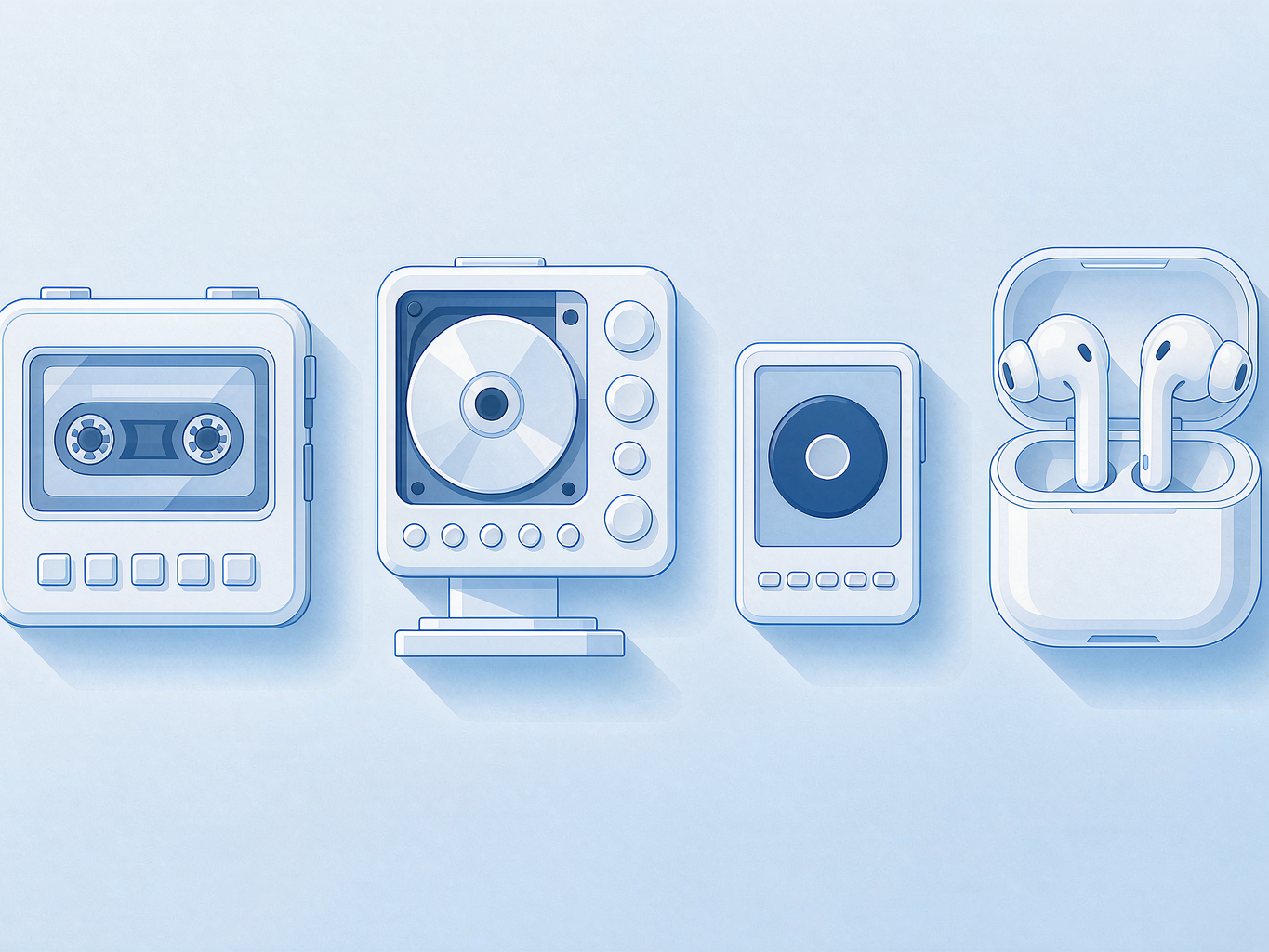
Forty years of personal audio is not a story about better sound. It is a story about deleting physical constraints. The Walkman put a cassette mechanism in a pocket and deleted the shelf. The portable CD player deleted the tape. The MP3 player deleted the moving parts. Bluetooth deleted the wire to the ears. True wireless deleted the wire between the ears, moved the battery into a case you have to remember to charge, and turned a mechanical product into a firmware product. Each step made the hardware smaller and pushed the hard work further into electronics, acoustics and software — which is exactly where sourcing risk sits today.
If you buy audio hardware for a living, that framing is worth more than the nostalgia. Read it as a sequence of constraints being removed, and you can predict where the next cost and the next complaint will land.
1979: a pocket that played, and a button nobody remembers
The first Walkman, the TPS-L2, went on sale in July 1979 at roughly US$150–200 — somewhere around US$700–900 in today's money. Two AA cells bought you 8 to 15 hours of playback. It had no recording function, no speaker, and no display. What it did have was two 3.5 mm jacks, so two people could listen to one tape, and a physical "Hot Line" button that ducked the music and opened a small built-in microphone so you could talk to the person next to you without pulling the headphones off.
That button is the direct ancestor of transparency mode, and of the pass-through conversation feature that every translation earbud we build ships with. Sony sold more than 200 million Walkman units across all formats by 2010.
The cassette's real limit was mechanical, not electrical. Tape speed drifts, heads wear, a C90 gives you 45 minutes per side, and the motor is the single largest battery draw in the product. Everything that went wrong with a Walkman went wrong in the mechanism.
1982–1999: the media shrank, then disappeared
Compact disc arrived in 1982 and became portable with players like the 1984 D-50, which cost roughly US$350 and needed a pocket of its own. CD deleted the tape transport, and introduced something no cassette ever had: a skip. Any hard knock disturbed the laser's tracking, so buffer memory — 10 to 40 seconds of pre-read audio — became a headline specification. Buyers were suddenly comparing RAM, not wow and flutter.
MiniDisc followed in 1992: 74 minutes per disc, rewritable, magneto-optical, compressed with ATRAC at a few hundred kilobits per second. Technically elegant, commercially stranded. Sony kept the format proprietary, the media expensive, and the marketing Japan-first, and it never reached volume in the US or Europe.
Then the media vanished. In 1998 the MPMan F10 and the Diamond Rio PMP300 shipped with 32 MB of flash — around eight songs at 128 kbps — for about US$200. Three years later a 5 GB hard-drive player held 1,000 songs.
| Generation | What it deleted | Typical capacity | Playtime on one charge/set | What broke |
|---|---|---|---|---|
| Cassette (1979–) | The shelf, the room | 60–90 min per tape | 8–15 h on 2× AA | Motor, belts, head wear |
| Portable CD (1984–) | The tape | 74 min per disc | 4–8 h on 2× AA, plus a spare set | Tracking skips, laser dust |
| MiniDisc (1992–) | The bulk, the skip | 74 min per disc | 10–20 h on 1× AA | Ecosystem, media price |
| Flash / HDD player (1998–) | The media | 32 MB → 160 GB | 10–30 h internal | DRM, drive shock, battery ageing |
| Wireless to the ears (2004–) | The cable to the phone | Streaming, no storage | 5–10 h per headset | Pairing, latency, codec mismatch |
| True wireless (2015–) | The cable between the ears | Streaming, plus case reserve | 4–8 h buds, 20–40 h with case | Bud battery, connection drops, fit |
Notice the pattern in the last column. Each generation solved the previous generation's failure and created a new one. Nobody in 1994 was worried about codec negotiation.
2001–2014: the drive, then the phone that ate it
The 2001 hard-drive player is remembered for the interface and the store that followed it in 2003 with 200,000 tracks at 99 cents each. Under the shell, the interesting part was a 1.8-inch Toshiba drive, a 10-hour battery and FireWire, in a body about 20 mm thick. Within four years flash had replaced the drive at the low end, and within ten years a US$20 flash player was a commodity.
Then the phone absorbed the whole category. That is the most useful lesson in this entire timeline for anyone building a hardware business: when a dedicated device's only remaining advantage is that it is a separate device, the phone takes it. The same argument is being made right now about translation hardware and about smart glasses — and it is only half right, which is a subject for another article.
The cable goes: three new problems arrive in exchange
Stereo audio over Bluetooth became practical with A2DP, added to the spec in 2003 and shipping in volume from around 2004. The first stereo headsets ran 5 to 10 hours, weighed as much as a phone, and streamed SBC at a bitrate that made cymbals sound like static.
Deleting the wire created three problems that had never existed before:
- Pairing. A Bluetooth address identifies a radio, not a person. Multi-device switching, reconnection order and "which phone is it attached to" became support tickets.
- Latency. SBC over A2DP typically lands 150–250 ms end to end. Lip sync starts feeling wrong above roughly 45 ms of audio-visual offset, which is why "gaming mode" exists — it drops latency to 60–80 ms by trading bitrate and buffering.
- Power. A radio that must stay associated consumes current even when nothing is playing.
Then came codec negotiation, the least visible and most misunderstood part of the stack. A phone supporting aptX, AAC and SBC paired with a bud supporting SBC will use SBC, and neither device tells the customer why. The link always settles at the floor of what both sides support.
2015–2016: the last cable goes, and the battery changes address
True wireless arrived in a cluster: a Japanese audio brand shipped the first pair in late 2015, a crowdfunded startup put sensors in its version the same year, and in December 2016 a pair with a custom low-power chip landed that finally made pairing and standby drain tolerable for normal people.
What actually changed was where the power lives. A TWS bud carries roughly 40–60 mAh, which buys 4 to 6 hours. The case carries 300–600 mAh and does the rest. So every true wireless product is a three-part energy problem: bud, case, and the phone's radio. Advertised playtime is the product of all three, which is why two brands with the same bud cell can print very different numbers.
The other change was architectural. The acoustic engineer now shares a cavity the size of a fingernail with a battery, two or three microphones, an antenna and a flex PCB. A 13 mm driver in that space is a compromise, not a design freedom. Active noise cancelling only reached mainstream TWS in the 2019 generation, once the silicon was cheap enough to sit inside the bud.
The three things that never changed
The seal. Everything upstream of the tip got smarter for forty years. The last centimetre did not change at all. A properly seated silicone tip still delivers 15–25 dB of passive blocking at higher frequencies, and no amount of firmware substitutes for it. The single biggest predictor of whether a customer likes a pair of earbuds remains the fit kit in the box.
Battery chemistry. Rechargeable lithium cells improve energy density at roughly 3–5% a year. That is a slow curve, not a doubling curve. Any "40-hour earbud" on the market is carrying a bigger case, not a miracle cell — and anyone promising a three-fold battery jump is showing you a prototype, not a product.
Tuning. Two factories can build from an identical bill of materials and ship products that sound like different brands, because the sound is decided in the DSP and in the acoustic damping, not in the parts list. This is the most common surprise for first-time buyers, and it never appears on a quotation.
What this history is actually worth to a buyer
| Lesson from history | What to do about it in 2026 |
|---|---|
| Every generation's "impossible" became a commodity in about eight to ten years | Do not pay a premium for a feature you expect to be standard next year. Pay for the tuning and the validation you cannot buy later. |
| The last 20% of performance has always been engineering hours, not part cost | Budget for tuning iterations and real-ear validation as line items, not as goodwill. |
| Early adopters forgive reliability problems; the mass market does not | If your channel is retail rather than enthusiast, weight connection stability above every headline spec. |
| Format winners were decided by content and licensing as much as by hardware | Check whether the app, cloud service or codec your product depends on will still exist in three years. |
| Fit and comfort were never solved by electronics | Ship three or more tip sizes, and test them on real people before tooling. |
A nostalgia product is a modern product in an old case
We had a client in Western Europe — a small brand with a strong foothold in independent record shops — who asked us to build a Bluetooth cassette player. A working tape mechanism, modern radio, shell styled after a 1983 pocket player. Industrial design was the easy part. Tooling was the easy part.
The first prototype round failed on things the original never had to think about. The tape motor injects broadband electrical noise, and the only place left to put the antenna was under the cassette door — which is where the motor's magnetic field lives. Round one dropped the Bluetooth link every 30 to 40 seconds whenever the tape was running. We ended up moving to a belt drive with a shielded motor can, adding a ferrite bead on the supply rail, and re-laying the ground plane. Three weeks and one extra tooling revision, and the product shipped.
The client summed it up better than we could: a nostalgia product is a modern product wearing an old case. The tape is scenery. The radio, the battery and the antenna are the product.
Where the next ten years point
LE Audio, added to the Bluetooth specification with version 5.2 in 2020, replaces the old codec with LC3 — similar quality at a lower bitrate — and adds multi-stream, so left and right no longer have to relay through each other. Its companion feature, Auracast broadcast audio, lets one transmitter feed an unlimited number of receivers. That matters for gyms, airports, stadiums, museum tours and conference rooms far more than it matters for music listening.
On-device AI is the second shift: wake-word detection, translation and noise classification running locally instead of round-tripping to a server. It is what allows a translation earbud to answer in under a second without a data connection. Wake words such as "Hey Cyan" are already a shipping feature rather than a demo.
Open-ear designs are the third. A meaningful share of users decline to block their ear canal at all, and that preference built a category that did not exist a decade ago. The acoustic problem is harder than it looks — no seal means no passive bass — which is why the good open-ear models are the ones with the least ambitious frequency-response claims.
Our stance
Do not buy a form factor you cannot service. If the tip or the ear hook is not replaceable, the product has a shelf life measured in months regardless of what the driver is made of.
Do not inherit an old design without re-validating the acoustics. History-inspired industrial design sells the first unit. Fit sells the second.
Do not pick hardware on codec spec sheets alone. A mediocre codec with a well-designed antenna and a clean ground plane beats a flagship codec on a badly laid-out PCB. Ask for the conducted and radiated test data, not the codec logo.
Do not buy a sensor you cannot verify. Heart rate, temperature and in-ear detection are only worth paying for if the factory will show you the readings on real ears with the shipping firmware.
Forty years of this industry says the same thing in every decade: the parts get cheaper, and the integration stays expensive.
Building a personal audio product?
We develop TWS, open-ear, bone conduction and translation models with vetted Shenzhen partner factories — from acoustic tuning and tip-kit design through connectivity validation and pre-shipment inspection. Most inquiries get a reply within one business day.
See our wireless earbuds range →