
A brief history of translation devices: from phrasebooks to AI earbuds
Four decades of machines that promise to remove the language barrier — what each generation actually solved, what it quietly handed to the next one, and why latency is now the number that matters.
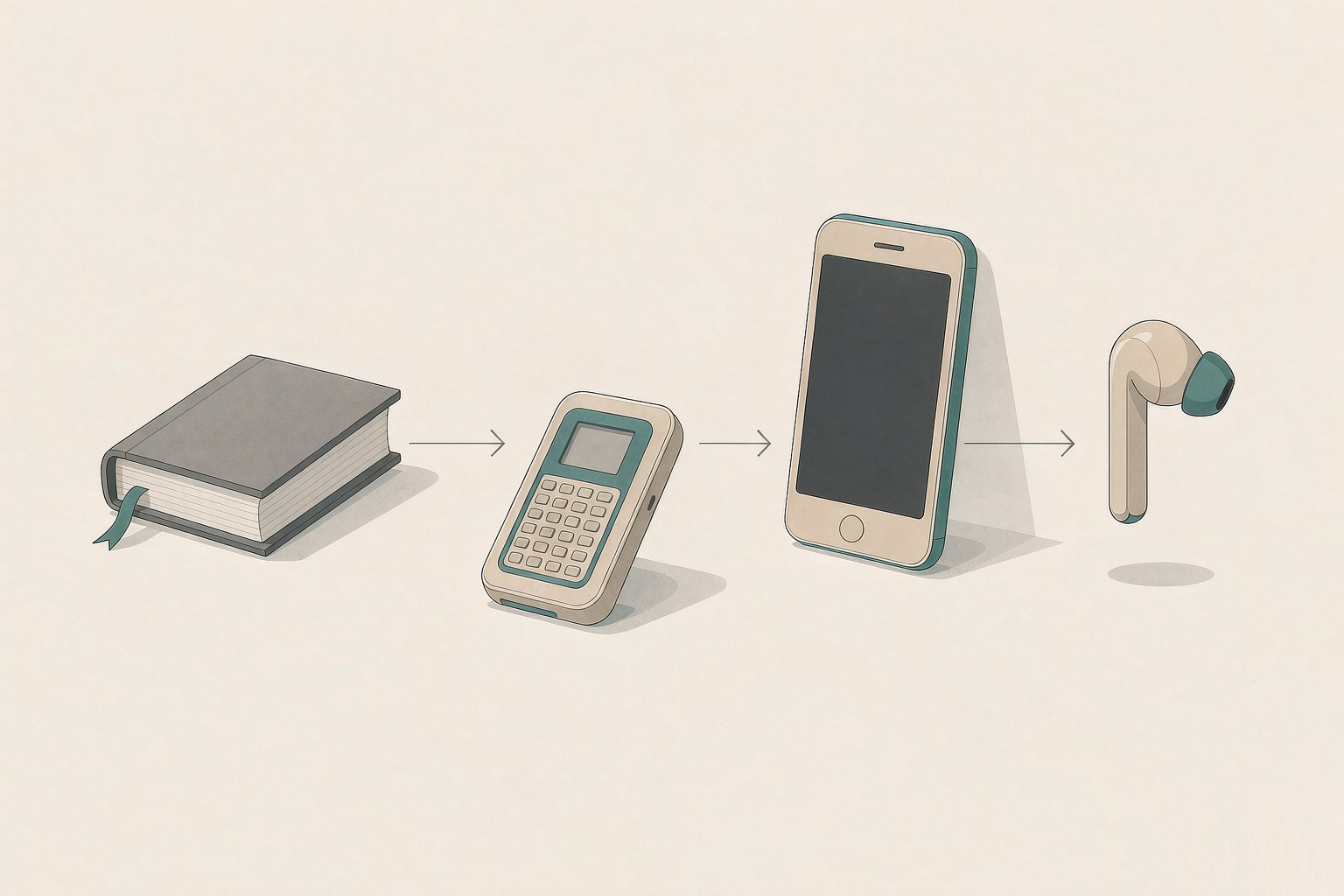
Every translation device since the 1970s has been fighting the same three problems: where the words are stored, who does the listening, and how long the other person has to wait while you work the machine. The phrasebook answered the first problem and left the other two to you. The first handheld electronic dictionary put a real dictionary in a pocket in 1978, then made you type with your thumbs. The phone app in 2006 did the listening, but you still had to hold it up between two faces. The AI earbud is the first form that took both the lookup and the listening away from the user — which is why the specification that decides whether one is any good is no longer the language count. It is round-trip latency.
Three problems, four generations
Read the history as a relay race rather than a series of inventions. Each generation handed one unsolved problem to the next, and the handover is where the interesting failures live.
| Generation | What the user does | What the machine does | What it still cannot do |
|---|---|---|---|
| Printed phrasebook 1900s–1970s | Finds the sentence, reads it aloud, points at the page | Stores a fixed list of sentences chosen in advance | Anything outside the printed list |
| Electronic dictionary 1978–1990s | Types the word on a keyboard, reads the screen | Looks up stored word pairs in ROM | Hear you. Speak back. Handle a full sentence |
| Phone app 2006–2015 | Unlocks, speaks or points the camera, shows the screen | Recognises speech, translates, renders text | Get out of the user's hands |
| AI earbud 2017–now | Talks normally | Listens continuously, translates, speaks into one ear | Run all day, work offline, stay under a second |
Generation one: the phrasebook wrote your sentences for you

For most of the twentieth century, translation hardware was paper. The format was refined by Baedeker-style travel guides and later by military issue: the US Army printed a Vietnamese phrasebook in July 1962 that a conscript could use without ever having studied the language. The sentences were numbered, the pronunciation was respelled in English letters, and the local speaker could read the reply from the facing page.
That design decision — pre-selecting the sentences — is the reason phrasebooks survived so long. It removed grammar, vocabulary and pronunciation from the user's job in a single move. It also capped the product permanently: a phrasebook can only translate what an editor guessed you would need, and it cannot help when the answer is not the one printed opposite.
Everything that came afterwards kept the same bargain for another thirty years. The sentences simply moved off paper.
Generation two: the first machine that held a dictionary (1978)
The standalone electronic dictionary arrived in 1978, when Lexicon Corporation shipped the LK-3000 — a plastic case about 6 × 3 × 1.25 inches with a 33-key keyboard, a 16-character display and swappable language cartridges. Words and phrases went in through the keyboard and came back on the screen. Craig followed in 1979 with the M100, which took bilingual cartridges for English paired with other languages.
The engineering constraint explains the product. Each language cartridge carried a small ROM — the patent behind the LK-3000 describes cartridges holding up to 8,192 bytes — which is room for a few thousand word pairs and nothing else, and the machine accepted phrases of up to eight words. Lookup was a character-by-character search through a stored list, with results scrolling across a 16-character window. It was slow, and it was still a hit: for the first time a traveller could carry more than one language pair and reach it without a book.
Notice what the LK-3000 did not do. It did not listen, it did not speak, and it did not understand grammar. It converted a string of letters into a different string of letters. For the next twenty years that was the whole category.
Generation three: the keyboard decade and the speaking dictionary
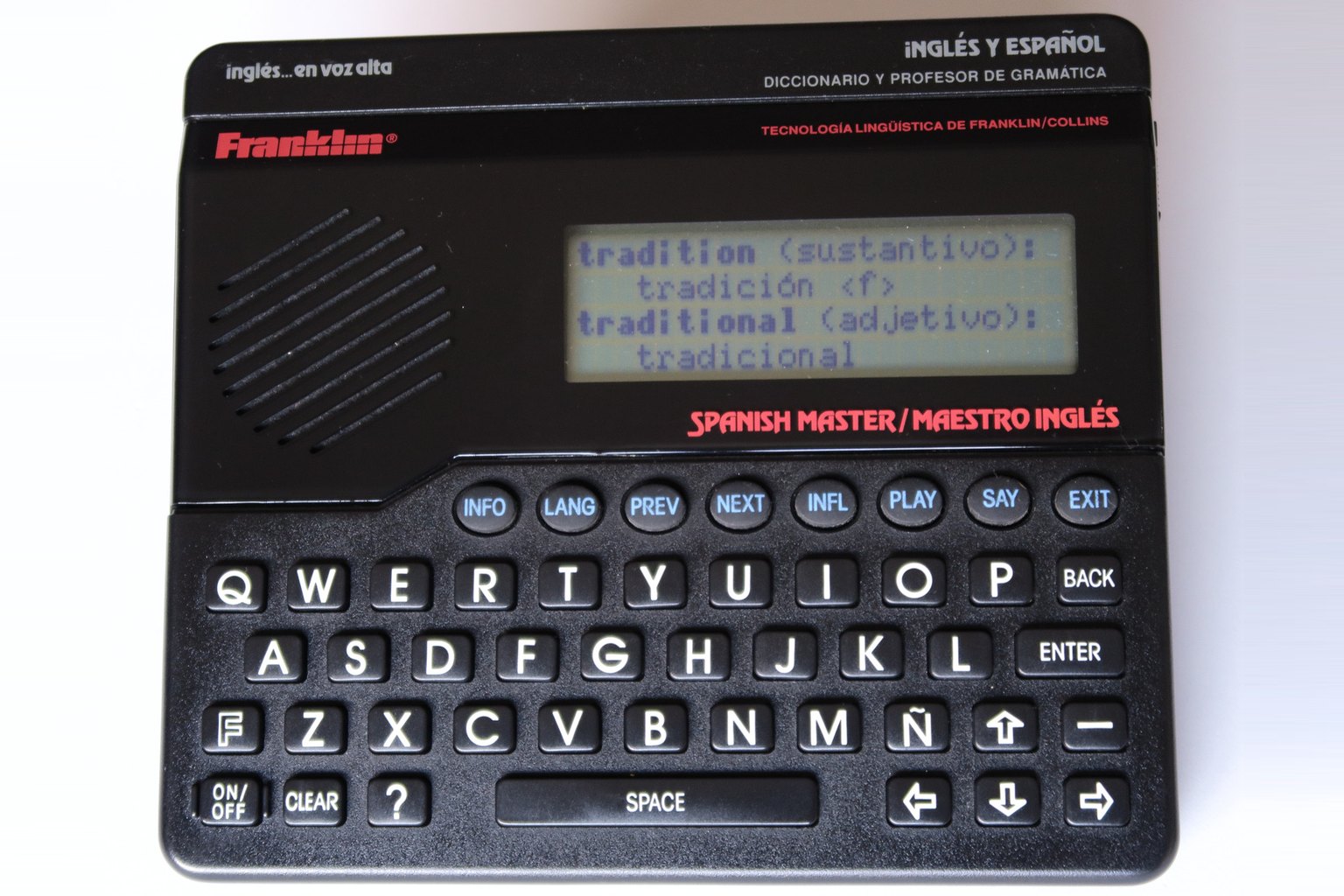
Franklin Electronic Publishers took the category mainstream in 1986 with the Spelling Ace, which retailed at around US$90 and later US$70. It was not a translator at all — it corrected spelling — but it put a keyboard, a screen and a licensed dictionary into a pocket, and it sold more than 800,000 units in its first two years. Twenty years later the same manufacturer was shipping speaking dictionaries built on Merriam-Webster content with 200,000-word databases, and word games on top.
The machines in this generation were genuinely useful and genuinely annoying, in the same way. Every trip through them was a three-step ritual: type the word, wait for the lookup, then turn the screen towards the other person so they could read it. Translation had become portable, but the conversation had not.
Two side-tracks from the same decade are worth remembering because they predicted what came next. First, optical scanning: from the late 1990s, pen-shaped scanners read printed text and looked it up, which moved input from typing to pointing. Second, talking dictionaries, which added a small speaker. Both ideas only became consumer-grade when they were handed a much better microphone and a network.
Generation four: the phone takes the job (2006–2015)
Google Translate launched in April 2006 as a statistical machine translation service and moved to neural translation in November 2016, which is when output quality jumped for the language pairs that matter in trade. But the decisive advantage was not the model. It was the hardware the model arrived on.
A phone in 2010 already had a microphone good enough for speech recognition, a camera that could read a menu, a screen both parties could look at, a data connection, and a battery the user charged every night anyway. Offline language packs later removed the connection from the requirement. Nothing in the dedicated-device market could answer that combination on price.
So the dedicated translator nearly disappeared — and the reason it did not disappear entirely is the useful part of this story.
The three things the phone never fixed
Ask anyone who has run a factory visit with a buyer who does not share a language, and you get the same three complaints. Each one is a hardware problem, not a software problem, which is why an app could not solve any of them.
- Somebody has to hold it. A phone sitting on a table between two people becomes the subject of the meeting. Handing your unlocked phone to a stranger is a trust problem, and in a negotiation it looks like one.
- Everything becomes turn-taking. Speech recognition needs a clean segment, so the conversation reorganises itself into an interview: you talk, I wait, the phone talks, I talk. A 20-minute discussion takes 40 minutes and loses the interruptions where deals are actually made.
- The network is often the problem. A basement showroom, a factory floor with steel walls, a trade fair with 80,000 people on the local cell tower, or a roaming SIM that costs more than the meeting. Cloud translation is excellent until the connection is not.
Generation five: translation moves into the ear (2017 onwards)
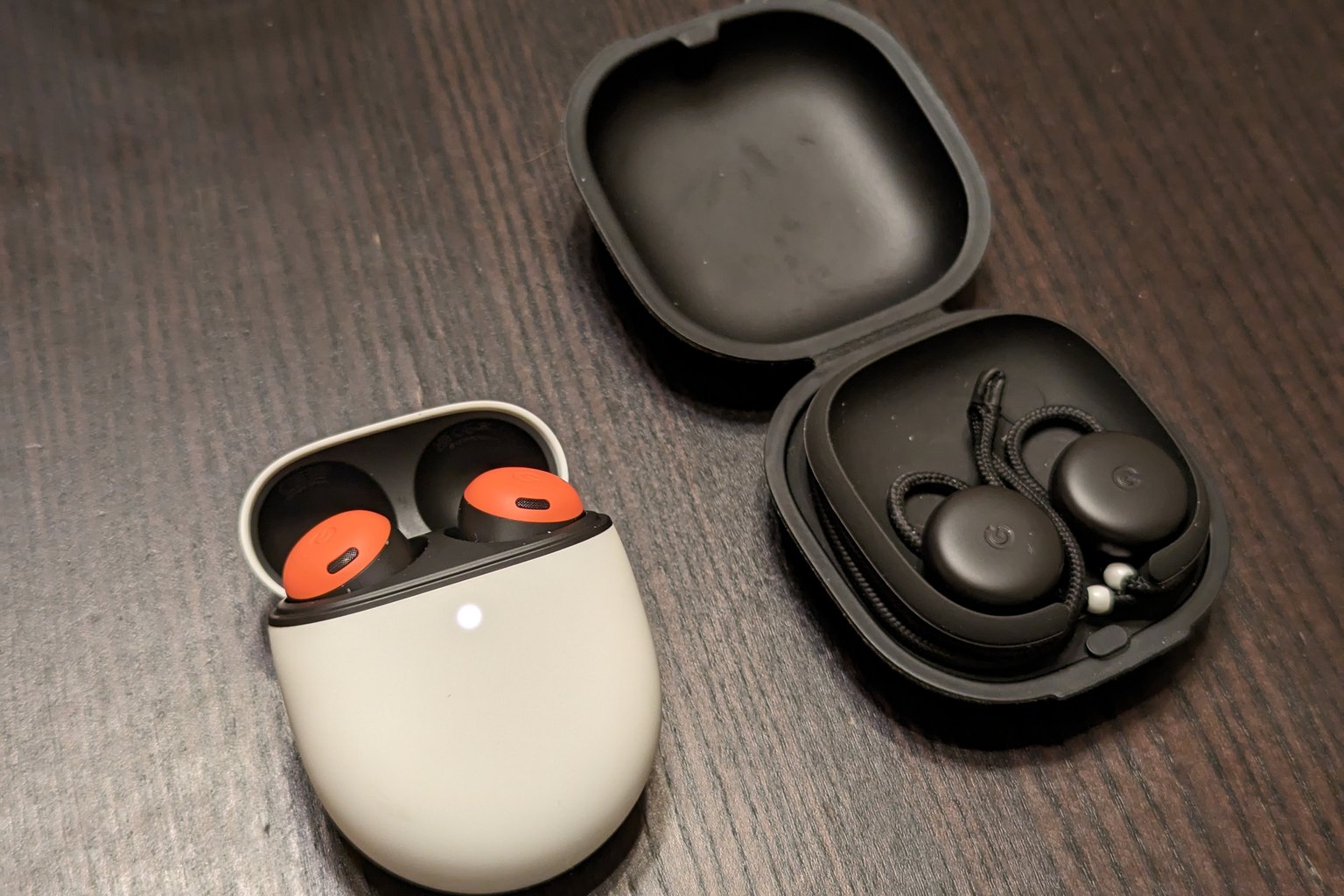
2017 is the year the category restarted. Google's first Pixel Buds promised real-time interpretation of a conversation, with the phone doing the work and the earbud doing the speaking. Sourcenext shipped Pocketalk, a dedicated handheld with its own connectivity, in Japan the same year. Timekettle put two earbuds into a single conversation — one for each speaker — with its first product on Kickstarter in 2017.
The architectural change underneath all of them is the same: the microphone moved to the ear. That sounds cosmetic. It is not. A microphone at the ear hears what the wearer hears, at a stable distance from the mouth, and a speaker at the ear can deliver the translation to exactly one person without the room hearing it. Remove the screen from the loop and two things happen at once — the user's hands are free, and the translation can arrive while the other person is still speaking.
That last point is where the modern specification came from. Once the device interprets continuously instead of waiting for a button, every design decision turns into a latency budget: how long a speech segment to capture before translating, how much of the language model to keep on the device, how many microphones to listen with, and how much battery to spend staying awake. Google's first Pixel Buds, announced in October 2017, were quoted at 5 hours of listening and 24 hours with the charging case — and those are music numbers, published before any translation engine was competing for the battery.
What a translation earbud specification actually means
When a supplier quotes a translation earbud, five numbers decide whether the product will be usable in the field. They are rarely on the page, and all of them are worth asking for in writing.
| Specification | Why it decides the experience |
|---|---|
| Round-trip latency | Measured from the end of the speaker's sentence to the start of the translation. Under about 2 seconds a conversation still feels like a conversation; past 5 seconds both parties start repeating themselves. |
| Segment length | How much speech the device captures before it translates. Long segments are more accurate and slower. This single setting is usually what buyers are really arguing about when they say a device "feels laggy". |
| Offline language list | Which pairs work with no network, and how much storage they take. "40 languages" commonly means 40 online, with a much shorter list installed on the device. |
| Microphone count and placement | Two microphones on one earbud are not the same product as one microphone per earbud in a two-earbud conversation. Ask which speaker each microphone is optimised for. |
| Talk time against listening time | Continuous interpretation drains a battery far faster than music playback. A claim of 6 hours of playback can mean well under half that with the translation engine running, so ask for the figure with interpretation on. |
One warning about the parts of this list that look cheap to change later. Firmware can be updated over the air. The microphone count, the segment length and the radio module cannot — and swapping the radio module means a new compliance report, which is a 2-week exercise even when the tests pass first time. Buyers who ask for "just one more language" 3 weeks before the ship date tend to find this out the hard way.
Our stance
Do not buy the word "AI". It appears on every product page in the category and distinguishes nothing. Ask for the round-trip latency, the segment length the firmware ships with, and the offline language list — then test all three with the accent your customers will actually meet.
Do not promise your customers a language pair that only works online. The airport, the hospital basement and the construction site are where translation hardware earns its keep, and they are exactly where the signal is worst. If a pair is not installed on the device, say so in the marketing copy.
And do not accept a demo as evidence. A controlled demo in a quiet room with a cooperative speaker is the easiest test in the world to pass. Run the same conversation in a noisy room with two people talking over each other, and the ranking of the devices usually changes.
One sourcing note survives every generation on this list: a translation earbud is quoted per model per colour from 1,000 pcs, and each extra language bundle, microphone layout or wake-word option becomes a variant that has to be certified, packaged and stocked separately.
The pattern worth remembering
Every generation in this history removed one bottleneck and inherited a new one. Printing removed the need to know grammar and imposed a fixed script. The 1978 dictionary removed the book and imposed the keyboard. The phone removed the dedicated device and imposed the screen. The earbud removed the screen and imposed electricity, latency and network coverage.
That is why the language count on a box tells you almost nothing. The next bottleneck is already visible: not how many languages a device claims, but whether it can hold a two-hour meeting on one charge, in an accent it was never trained on, in a room with no signal. Buyers who judge hardware that way tend to be the ones whose products come back with good reviews. If you are comparing the three form factors for a specific customer, the breakdown is in earbuds vs handhelds vs phone apps, and the sourcing checklist for earbuds specifically is in the AI translation earbud guide.
Sourcing AI translation earbuds?
Tell us the language pairs, the market and the environment your customers will use them in. We will tell you which of the five specifications above will decide the experience, and which ones the factory can actually control.
See our AI translation earbuds →