How ANC actually works: what active noise cancelling can and cannot cancel
The inverted-wave trick, the three microphone architectures, why "up to 48 dB" is measured on a rig instead of on an ear, and the spec questions that turn an ANC claim into something you can compare.
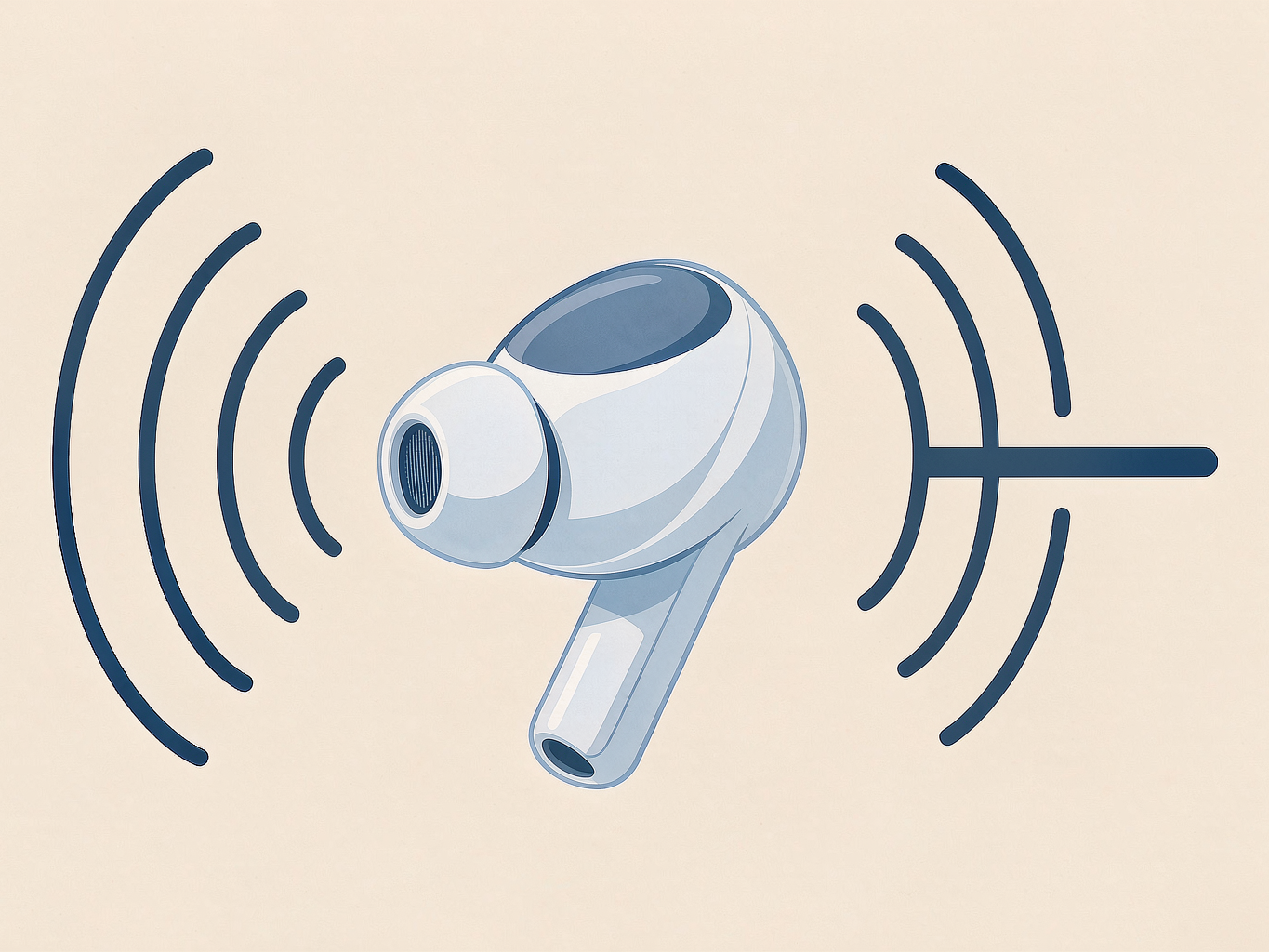
Active noise cancelling listens to the noise around you and plays back its mirror image. A microphone captures the ambient sound wave, a DSP flips that wave upside down in a fraction of a millisecond, and the driver emits the inverted copy. Where the original and the inverted wave meet, they cancel each other out. That is the entire mechanism, and it explains both ends of the product's reputation: ANC is genuinely good at steady low-frequency rumble — a jet cabin, a bus engine, an air conditioner — and close to powerless against speech, a dropped fork, or a crying baby.
For a buyer, that gap is the whole conversation. The technology is not mysterious. The numbers used to sell it, on the other hand, are.
The physics sets the ceiling, not the brand
Cancellation only works if the inverted wave arrives at your eardrum still inverted. Sound travels at roughly 343 m per second, so wavelength shrinks fast as frequency rises. A 100 Hz rumble has a wavelength of about 3.4 m. At 1 kHz it is 34 cm. At 4 kHz — where a lot of speech intelligibility and keyboard clatter lives — it is 8.6 cm.
The anti-noise path has to stay inside a fraction of that wavelength. At 100 Hz the DSP has milliseconds to spare and can be sloppy. At 4 kHz it has microseconds, and any phase error does not just fail to cancel — it adds energy. That is why every ANC product in the world starts losing effectiveness above roughly 1 kHz, and why the honest ones stop advertising there.
| Frequency | Wavelength | Typical hybrid ANC (real ear) | What lives here |
|---|---|---|---|
| 50–150 Hz | 6.9–2.3 m | strong, often 25–35 dB | Aircraft cabin, bus and truck engine, HVAC hum |
| 150–500 Hz | 2.3–0.7 m | good, 12–20 dB | Fan noise, road rumble, distant traffic |
| 500 Hz–1 kHz | 0.7–0.34 m | modest, 5–10 dB | Vacuum cleaner, loud conversation at distance |
| Above 1 kHz | under 34 cm | near zero, sometimes negative | Voices, keyboard, cutlery, alarms, baby |
Read that last row twice. The noises that make an open-plan office unbearable sit almost entirely outside what ANC can touch. Passive blocking from a well-sealed tip does more for you above 1 kHz than the electronics ever will.
Three architectures, and what each one costs you
Where the microphone sits determines what the system can correct, and what it gets wrong.
| Feedforward | Feedback | Hybrid | |
|---|---|---|---|
| Mic position | Outside the shell, facing the room | Inside the nozzle, facing the ear canal | Both |
| Mic count | 1 per bud | 1 per bud | 2–3 per bud, so 4–6 in the set |
| Strength | Sees noise before it reaches the ear; wide usable band | Measures the error at the ear, so it self-corrects for fit and leakage | Low-frequency depth plus fit correction |
| Weakness | Cannot know how much noise actually arrived — a loose tip fools it | Exposed to the wearer's own voice; tighter latency budget; can go unstable | More mics, more DSP, more power, more tuning work |
| Wind | Worst case — the outer mic sits directly in the airflow | Largely sheltered from wind | Needs a dedicated wind-detection routine to mute the outer mic |
Almost every current TWS model that advertises real ANC is hybrid, usually with two mics per bud for cancellation and a third for voice pickup. Feedforward-only designs still exist at the entry end, and they are not automatically bad — a feedforward bud that seals well can beat a poorly fitted hybrid. But a feedforward spec sheet will not tell you about the leakage problem, because the design cannot see it.
"Up to 48 dB" is a peak, at one frequency, on a rig
Here is the part most buyers never get told. There is no consumer standard for ANC depth. Hearing protectors are measured against EN 352 or ANSI S3.19, which produce an insertion-loss rating. Consumer ANC earbuds have no equivalent mandatory test, and no certification body verifies the number printed on the box.
So the figure comes from the vendor's own lab, and the lab chooses the method. In practice that means pink or white noise at 75–85 dB SPL, played in an anechoic chamber or through a head-and-torso simulator, and then the best attenuation point is quoted. A "48 dB" headline is usually the peak, sitting somewhere around 100–200 Hz. Averaged across the full 50 Hz–1 kHz band, the same product might measure 20 dB.
Both numbers can be true. They mean completely different things to a customer standing on a platform. When we audit a factory ANC claim, four questions separate a real figure from a marketing one:
- Which standard or in-house method, and at what SPL?
- Is the quoted figure a peak or a band average, and over which band?
- Was it measured on a rig, or on human ears with the shipping tip?
- Can I see the raw attenuation curve, not the summary line?
A supplier who has done the measurement will answer all four in one email. A supplier who has not will send the same one-line spec sheet again, more slowly.
The 10 dB that lives in the ear tip
This is the single most useful thing to understand about ANC, and it is the one factories rarely put in the presentation.
Before any electronics switch on, the tip is already doing passive work — 15–25 dB of blocking at higher frequencies if it seals, and dramatically less if it does not. ANC then adds its contribution. But ANC depends on the acoustic path it is modelling. A leaky tip changes that path: low-frequency energy that ANC was supposed to cancel goes around the seal instead, and the feedback mic suddenly has a moving target as the wearer shifts their jaw.
In measurements we have seen, a change of one tip size on the same earbud moves low-frequency attenuation by 8–12 dB. That is more than the difference between an average ANC implementation and a good one. It is also the reason two reviewers wearing the same pair can report opposite results, and the reason your returns data will not match the lab report.
Practical consequence: if you are sourcing ANC, the fit kit is not an accessory line item. It is part of the acoustic design. Ask how many tip sizes ship in the box, in what materials, and whether a foam option exists for long-wear markets. Then insist that pilot validation happens on at least five real people who were not in the meeting.
What ANC quietly takes away
Battery. Cancellation runs continuously — the mics and DSP work whether or not music is playing. On a typical TWS, switching ANC on costs somewhere between 15% and 25% of playtime, and it also raises idle drain inside the case, which shortens the shelf time between charges. Any single "up to X hours" figure is meaningless unless it states ANC state, volume level and codec.
Wind. Blowing air across the outer microphone produces low-frequency turbulence, and the ANC loop faithfully amplifies it into a rumble. This is why a ride on a scooter can sound worse with ANC on than off. Wind-noise reduction is a separate algorithm from noise cancelling, and it needs to be requested explicitly and demonstrated with a recording or a live demo at 20 km/h or more.
Your own voice. A feedback mic inside the ear canal hears the wearer's voice conducted through the skull and reinforces it, so calls sound boomy and hollow to the person speaking. Venting the shell relieves the effect, but a vent is deliberate leakage, which costs low-frequency cancellation. There is no free version of this trade.
Comfort, for some users. Deep low-frequency cancellation creates a pressure sensation that a share of wearers find uncomfortable after 20–30 minutes. An ambient mode halves the effect but resets the battery maths again. Budget for it in the user guide rather than discovering it in reviews.
Writing an ANC spec you can actually compare
Put these eight lines in the RFQ and the quotations stop being incomparable.
| Ask for | Why it matters |
|---|---|
| ANC type and mic count per bud | Hybrid versus feedforward changes the failure mode, not just the depth |
| Attenuation curve from 50 Hz to 1 kHz, plus peak and band average | Turns a headline number into two numbers you can sanity-check |
| Test method, SPL, and whether it was on a rig or on ears | Reveals whether the figure will survive contact with customers |
| Tip kit: sizes, materials, spares included | The fit kit is worth 8–12 dB; treat it as acoustic hardware |
| Wind-noise reduction: on/off demo at 20 km/h or more | Catches the most common complaint from outdoor users |
| Playtime with ANC on, at a stated volume and codec | Makes the number comparable instead of promotional |
| Whether ANC tuning can be revised after the pilot build | Determines whether you can fix tonal complaints without new tooling |
| Real-ear validation: 5 or more wearers, shipping tips, written results | The only test that predicts your review section |
Where this goes wrong in practice
We had a client — a European accessories brand launching its first ANC product — who committed to 3,000 units off a spec sheet that read "42 dB". The hardware was fine. The problem was what the 42 dB referred to: a peak at around 120 Hz. The brand's launch copy promised relief on the train and in the office. On the train, customers were happy. In the office, where the noise is keyboards, chair scrapes and colleagues talking between 1 and 4 kHz, the product did nothing measurable, and the reviews said so within three weeks.
The second complaint arrived in the same reviews: wind rumble during calls on a bicycle, because the feedforward mic had no wind reduction enabled in that firmware build. Neither problem needed new tooling. One needed the spec to be read properly before the marketing was written. The other needed a firmware setting switched on — which the brand discovered only after the pilot build had already shipped.
Both could have been caught by a two-day real-ear test on ten units.
Our stance
Do not buy ANC on a depth number. Buy on the curve, the tip kit and a wind demo. A single dB figure, unqualified, tells you the vendor knows what buyers want to hear.
Do not let marketing promise silence. Promise lower low-frequency noise, which is what the product delivers. Every "silence the office" claim we have seen turn into returns started as copy written by someone who had never seen the attenuation curve.
Do not pay for hybrid if you cannot validate it. Hybrid costs more in mics, DSP tuning and power than a well-executed feedforward design. If your market is price-driven and your validation budget is one afternoon, a feedforward bud with a good seal and three tip sizes will outperform a hybrid bud nobody tuned.
And if you are selling into a call-heavy market, weight the microphone array and wind handling above depth. ANC depth is a checkout-page feature. Call quality is a returns-rate feature.
Sourcing an ANC product?
We build TWS, open-ear and over-ear models with vetted Shenzhen partner factories — hybrid or feedforward ANC, tuned to your target market, with real-ear validation and attenuation curve reports supplied before the pilot build. Most inquiries get a reply within one business day.
See our wireless earbuds range →