Birdbath vs waveguide: how to choose smart glasses display technology
Two optical architectures that look similar on a spec sheet and could not be more different in a factory. What each one really delivers in field of view, brightness, weight and lead time - and the six questions to put in an RFQ before you cut tooling.
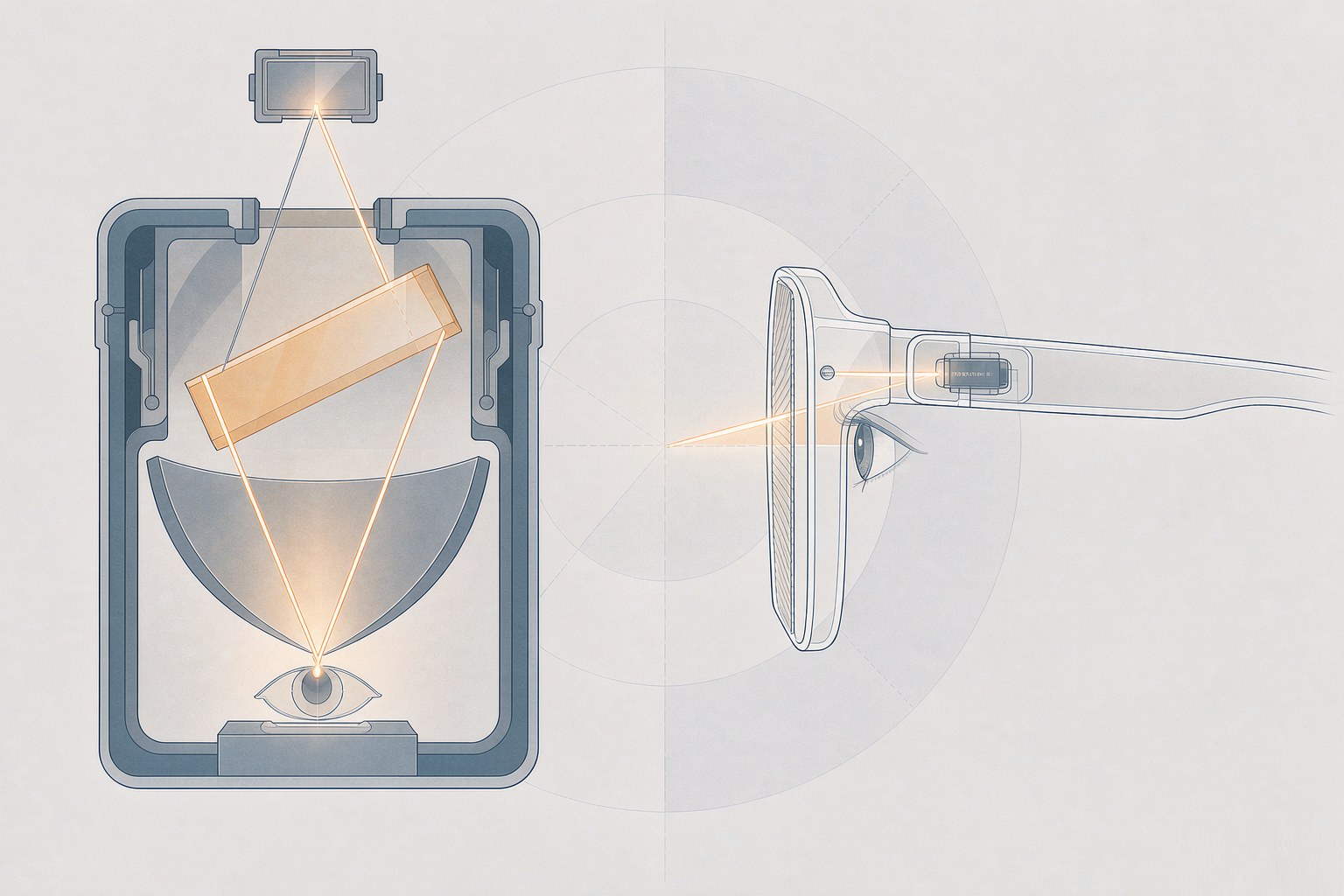
Choosing between birdbath and waveguide optics is not a question of which is better. It is a question of which set of compromises you can defend to your customer for the next two years. A birdbath gives you a brighter, wider, cheaper image inside an optical module roughly 25 mm thick that blocks about 75% of the light coming through the lens. A waveguide gives you a 1-2 mm plate that looks like ordinary eyewear, and charges you for it with a light engine bright enough to survive having most of its output thrown away. Field of view, outdoor readability, weight, tooling and lead time all fall out of that one decision, and it is one of the most expensive decisions to reverse after the frame is cut.
Two architectures and what each is buying you
Both architectures put a tiny image in front of the eye and let the wearer see the real world. That is where the similarity ends. Everything else - the number of optical surfaces, the microdisplay, the shape of the frame, the test equipment at the end of the line - changes with the choice.
| Property | Birdbath | Waveguide |
|---|---|---|
| Optical path | Microdisplay, 45-degree beam splitter, concave curved mirror, eye | Light engine couples into a thin plate, travels by internal reflection, exits through grating or mirror structures |
| Module thickness | Typically around 25 mm | Plate 1-2 mm; the volume moves to the temple |
| Light reaching the eye | Roughly 10-15% of panel output | Commonly 1-5% for the whole system; geometric designs several times better than diffractive |
| Real-world view | Heavily dimmed, close to sunglasses | Mostly clear; diffractive is around 80-90% transparent, geometric higher |
| Field of view | Often 46-57 degrees diagonal in shipping consumer units | Typically narrower; consumer units cluster well below 50 degrees |
| Image quality | Good colour uniformity, almost no rainbow artefacts | Rainbow artefacts and eye glow are the classic diffractive problems |
| Best fit | Tethered media glasses, phone and laptop mirroring, gaming | Information display worn in public, navigation, notification, translation |
Birdbath: the best image you can buy, in the thickest module
The name comes from the shape. A small micro-OLED panel sits above or below the line of sight. Its light hits a 45-degree beam splitter, which sends it down onto a curved, partially reflective mirror shaped like the inside of a birdbath, and that mirror focuses the image back through the splitter and into the pupil. Three optical surfaces do all the work, and they are ordinary refractive and reflective surfaces, which is why the image is clean.
The cost of that simplicity is light and volume. Optical analyses of shipping consumer units put the light reaching the eye at somewhere between 10% and 15% of panel output - a 1,000-nit micro-OLED ends up around 120 nits at the pupil. The same analyses put real-world transmission at roughly a quarter of incoming light, so the wearer is looking through something close to dark sunglasses even when the display is off. And the beam splitter and mirror need an air gap between them, which is where the 25 mm comes from. Nothing about that geometry is a manufacturing defect; it is what the design is.
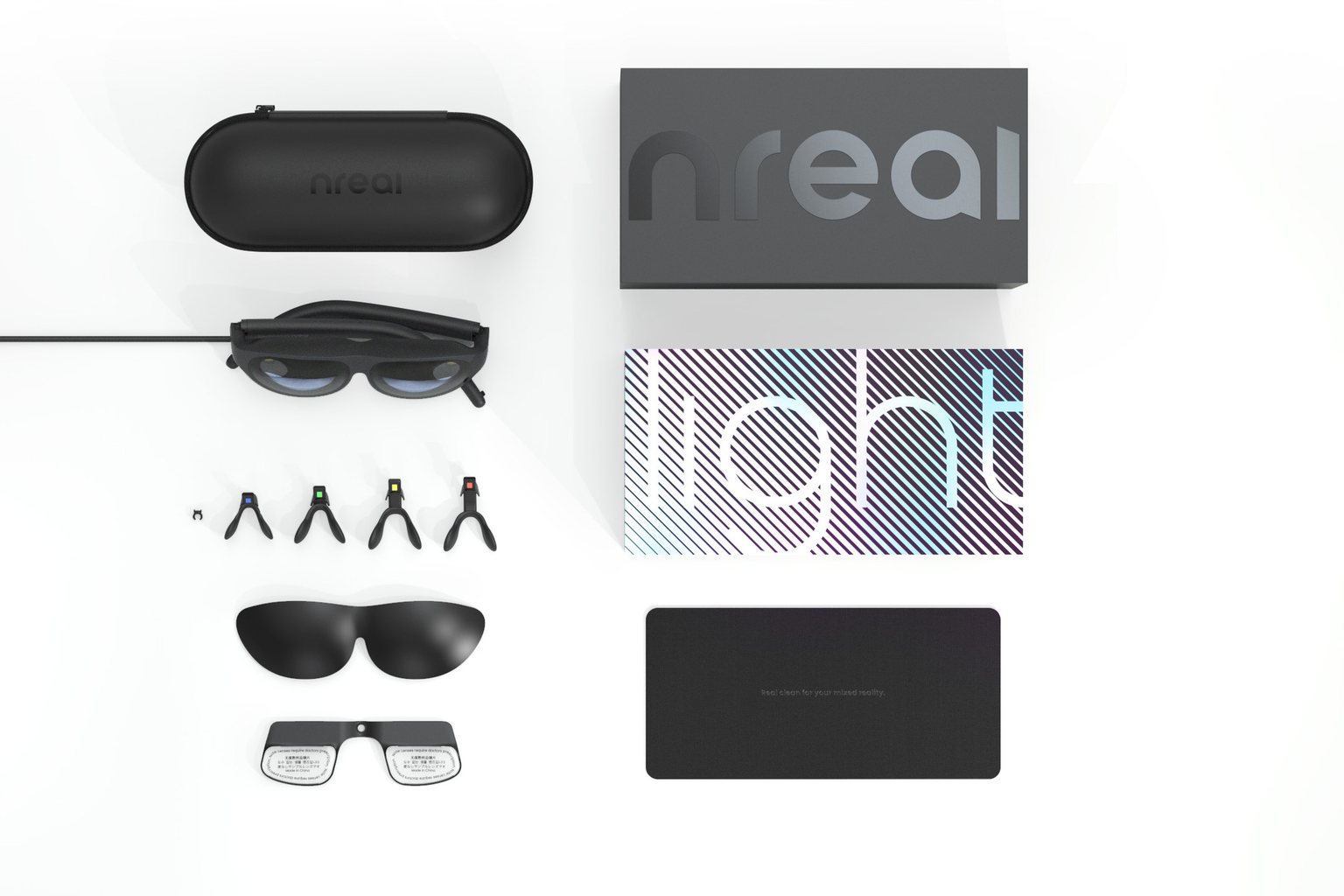
What birdbath buys you is worth naming precisely, because it is easy to lose. A large eyebox - the window you can move your head inside before the image degrades - comes free from the magnifying mirror. Wide field of view comes from being able to place the panel far from the eye. Colour uniformity comes from not using diffraction at all. For a product whose job is to put a 100-inch virtual screen in front of someone on a long flight, that combination is close to ideal, and it is why the entire display-glasses category from 2020 to 2025 was built on it.
Two practical notes for buyers. First, the micro-OLED is usually the most expensive single component in the bill of materials, and it comes from a small number of fabs, so your cost and your supply risk sit with the panel, not with the assembly line. Second, the darkness that makes the image readable in daylight also makes the glasses unusable as everyday eyewear, which caps the addressable market at media and gaming unless you add a dimming or electrochromic layer - and that layer is a new component with its own qualification cycle.
Waveguide: thin glass, and an engine fighting its own lens
A waveguide takes the opposite approach. Instead of folding light in front of the face, it couples the image into a flat plate of glass or plastic 1-2 mm thick, lets total internal reflection carry it across the lens, and releases it in front of the pupil through structures patterned onto the surface. The display engine disappears into the temple. The lens stays nearly as transparent as ordinary glass, which is the whole commercial argument: a waveguide frame can be worn in a meeting without looking like equipment.
There are two families, and buyers should know which one they are being quoted. Diffractive waveguides use nanoscale gratings, typically embossed or etched. They scale better in volume, but gratings bend each wavelength by a different amount, which is where the rainbow streaks and the forward light leakage that people notice on your face come from. Because each colour needs its own plate, full colour usually means two or three thin plates bonded with air gaps between them, and every extra plate costs light. Geometric - also called reflective or array - waveguides embed a stack of angled micro-mirrors inside the plate instead, so a single plate handles all three colours.
Efficiency is the number that decides everything else. Whole-system efficiency for a diffractive waveguide is commonly quoted in the 1-5% range: most of the light is lost at coupling in, inside the substrate, and at coupling out across the eyebox. Geometric waveguides are reported to be roughly three to seven times more efficient, which is why they can carry an LCoS engine at useful brightness where a diffractive plate would need something brighter and more expensive.
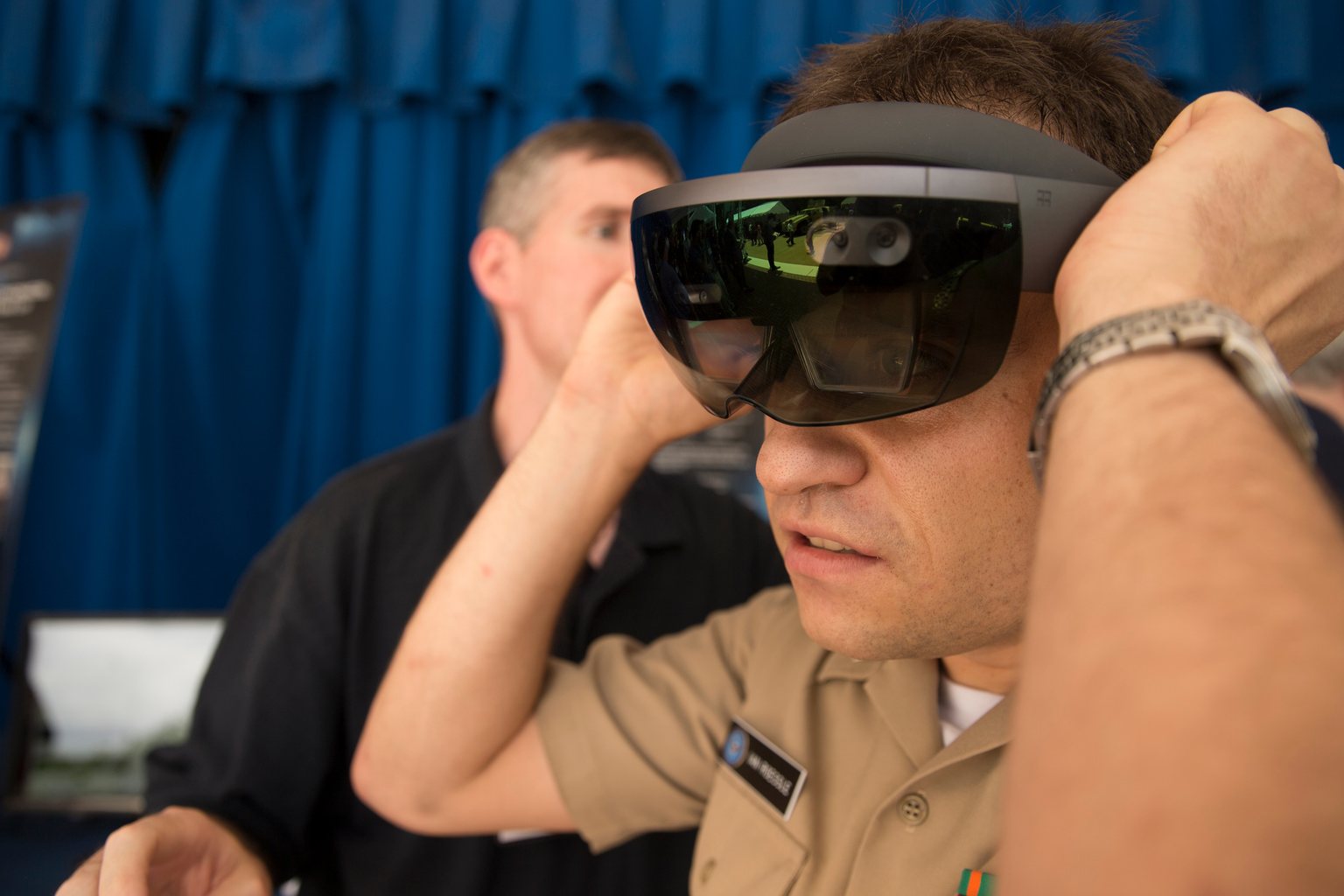
The data from that generation is still the most useful benchmark a buyer can carry into a meeting. The first HoloLens: about 34 degrees diagonal, roughly 40% see-through transmission, luminance at the eye around 320 cd/m2. Magic Leap One: about 45 degrees diagonal, but transmittance of only about 15% and around 220 cd/m2 at the eye, because it stacked six plates to fight colour problems. A geometric waveguide demo of the same era, Lumus DK-Vision: about 40 degrees diagonal, roughly 80% transmittance and about 1,000 cd/m2 at the eye - one plate, three times the light, but hard to make in volume. Read those four numbers together and the trade is obvious: the thin architectures win on form factor and lose on light, and the way they win light back is to make the engine brighter, which costs power and battery.
There is a second number that does not appear on most spec sheets and matters more than field of view in daily use: the eyebox, the volume your pupil has to sit inside. Waveguide eyeboxes are typically in the 8-12 mm range. That is small enough that a pair of glasses sliding 5 mm down your nose can make a corner of the image vanish. Exit pupil expansion structures widen the window, but they take more light to do it. Ask for the eyebox figure in millimetres, and ask whether it is quoted at full field of view or at the centre only.
The spec sheet is measuring two different things
This is where most purchasing arguments go wrong. The brightness number on a birdbath product sheet and the brightness number on a waveguide sheet are not the same quantity, so comparing them directly is meaningless. A birdbath sheet usually quotes what the magnified panel delivers to the eye. A waveguide sheet often quotes what the engine has to produce, because that is the impressive number.
| Spec | What it means on a birdbath sheet | What it means on a waveguide sheet |
|---|---|---|
| Brightness (nits) | Usually luminance at the eye, after the splitter and mirror losses | Often engine output, before 90%+ is lost in the plate. Ask for luminance at the eye |
| Field of view | Diagonal, and the horizontal figure is usually close behind it | Diagonal again, but a 20-degree diagonal monocular display is a 20-degree product |
| Resolution | Panel pixels; PPD follows from pixels divided by field of view | Same arithmetic, but resolution gets clipped by the waveguide modulation transfer function |
| Transparency | Rarely quoted because it is poor by design | Quoted as substrate transmission, without the light-blocking layers some designs add |
| Weight | Reported as total glasses weight, and often front-heavy | Reported as total glasses weight, with the mass concentrated in the temples |
| Artefacts | Ghost images from the splitter, usually minor | Rainbow streaks and eye glow, both worse at wide field of view |
The honest way to compare any two quotes is to normalize four numbers to the same measurement plane: luminance at the eye, field of view measured horizontally and vertically, eyebox in millimetres at full field, and total glasses weight. A supplier who cannot give you luminance at the eye either has not measured it or does not want to.
What the 2025 flagship changed
The product that reset buyer expectations was not the widest or the brightest. Meta's Ray-Ban Display, launched in the United States at US$799 including the wristband controller, put a single full-colour LCoS display and a geometric waveguide licensed from Lumus and manufactured by Schott into the right lens only. The published numbers: 600 x 600 pixels, about 20 degrees of field of view, 42 pixels per degree, 90 Hz refresh, 30 to 5,000 nits, light leakage under 2%, 69 grams, six hours of mixed use and 30 hours with the case, and support for prescriptions from -4.00 to +4.00. If you have been in this category for a while, all the interesting information is in the 20 degrees.
A mass-market brand looked at the trade-off and chose a small monocular window over a big one. It spent the engineering budget on weight, transparency, leakage and fit instead - the things a person notices while standing in a shop. That is a signal worth taking seriously, because retail expectations propagate backwards into OEM briefs within about two product cycles. A buyer who asked for 50 degrees and 1,500 nits at 45 grams in 2024 was asking for something physically inconsistent. A buyer who asks for a 20-degree window that weighs nothing and leaks no light is asking for something that now exists.
There is a quieter point in the same announcement. LCoS came back into favour for this product, after years of being treated as the older, cheaper option next to micro-LED. The reason is arithmetic: a geometric waveguide is efficient enough that a mature LCoS engine can reach the required luminance, which removes the need to wait for a micro-LED supply chain and its red-channel problems. Architecture choices upstream decide which display technologies are viable downstream.
Two supply chains, not one
Here is the part that surprises buyers most, especially those who have sourced earbuds or speakers. On most audio products, the factory that assembles the product also makes or integrates the transducer, and you are negotiating with one counterparty. On display glasses you are negotiating with several, and the one you signed with is often not the one holding the schedule.
Optics is the largest single block of cost in a pair of display glasses - trade estimates put the optical module near half the bill of materials - and it splits differently depending on architecture. A birdbath program is comparatively simple: a mature module design that many houses can build, paired with a micro-OLED from a handful of fabs. The vendor list is long, the tooling is well understood, and the commercial conversation is mostly about assembly price and volume.
A waveguide program splits into at least four vendors. There is the combiner supplier, who patterns or embosses the gratings onto glass wafers - a wafer-level process where high-index substrate material is a supply question of its own, with index-2.0 glass now offered for sampling in 150, 200 and 300 mm round wafer formats. There is the microdisplay vendor, working in LCoS, micro-OLED or micro-LED. There is the light engine integrator, who has to hit a luminance target that the combiner's efficiency set. And there is the frame and final assembly house, who is the party you actually sign with and the party with the least control over the other three.
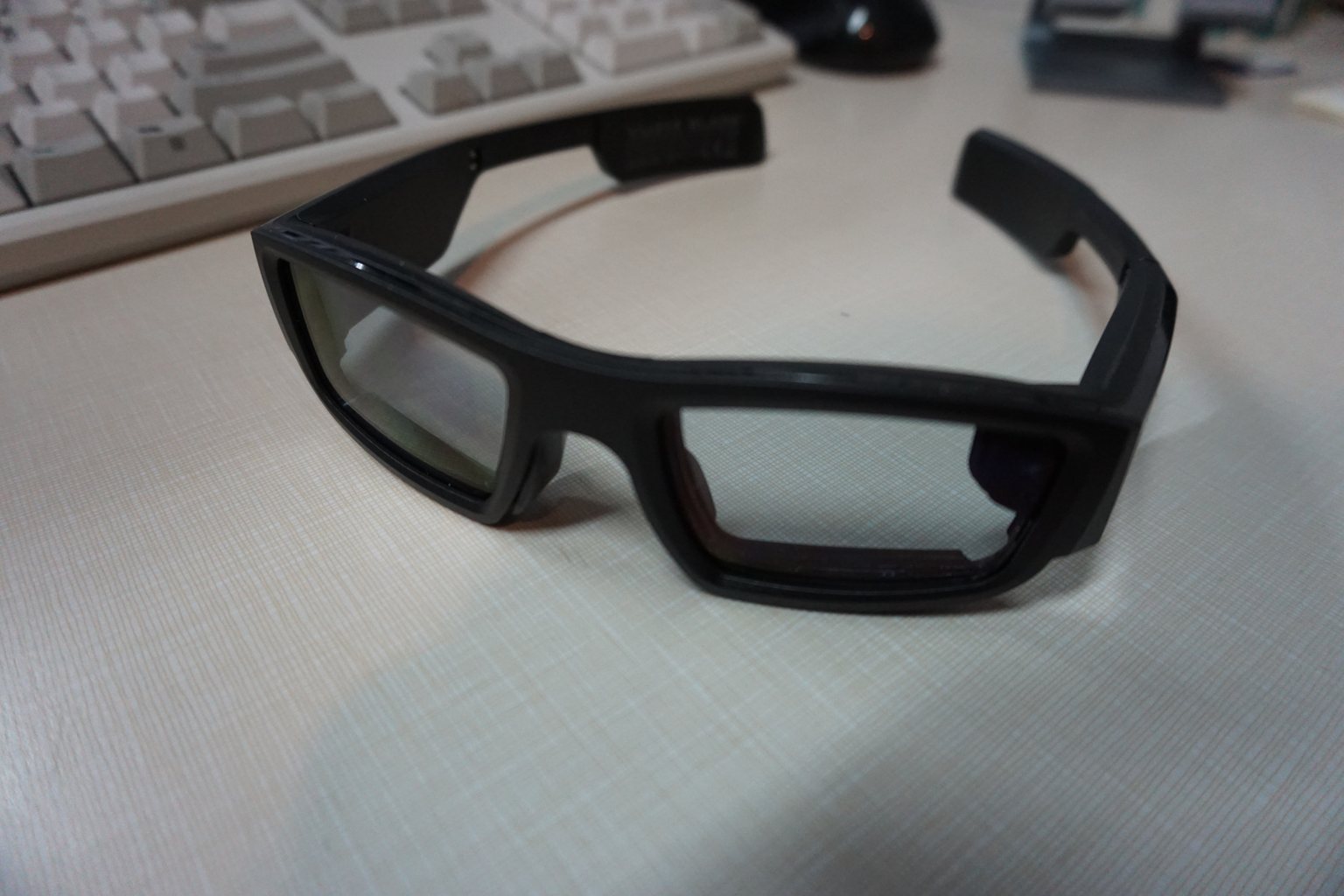
The practical consequence is lead time. On a birdbath program, your critical path is likely the micro-OLED allocation and your own tooling. On a waveguide program, your critical path is the combiner wafer and the engine build, both of which are quoted in capacity windows rather than days. Waveguide capacity has moved a long way from the laboratory - several houses now run lines in the tens of thousands to a million plates a year - but capacity for a specific wafer, thickness and grating pitch is still a small number, and it is shared with programs larger than yours. This is the reason to lock the combiner before you sign the assembly contract, not after. The general shape of that timeline risk is covered in the 90-day OEM timeline, and the sourcing patterns that apply here are the same ones described in sourcing electronics from Shenzhen.
We have sat through this conversation more than once. A European importer brought us a display-glasses brief that had been written around a waveguide: about 48 degrees of field of view, a target under 45 grams, and a retail position that assumed a tethered media viewer behind it. Those three could not hold together in one product. The version that shipped accepted a much smaller window and moved the mass into the temples, which meant a new frame design and a new optical drawing - but it shipped. The programmes that end badly are usually the ones where this trade is discovered after the tooling is cut rather than before, because by then the answer is a delay instead of a design change.
Six questions to put in the RFQ
Written answers to these six will let you compare two quotes from different architectures without being misled, and they will surface the schedule risk before it becomes a delay.
- Which architecture is quoted, and what is the total optical train thickness and weight? Not the glasses weight - the optical module. Birdbath and waveguide differ by an order of magnitude here, and it drives the frame design.
- What is the measured luminance at the eye, in cd/m2 or nits at the exit pupil? If the answer is engine output, ask again. This is the single most common way a waveguide quote is made to look brighter than a birdbath one.
- What is the field of view measured horizontally and vertically, and what is the eyebox in millimetres at full field? Diagonal field of view flatters the product, and an eyebox quoted at the centre only is not the number your customer will experience.
- Is the combiner a single plate or a stack, and who supplies the wafer? A stack means more loss, more weight and more assembly tolerance. Either way, you want to know which party holds your schedule.
- Which microdisplay, and is it second-sourced? Panel allocation is the most common hidden risk in both architectures, and for a waveguide it also has to match the engine's luminance budget.
- What is the light leakage figure, and will you put a rainbow and ghosting check in writing? Leakage is what your customer's colleagues see on their face. A supplier who will not commit a test criterion to paper will not pass it consistently.
What this means for your product plan
Pick the architecture from the use case, and let the spec sheet follow. If the product puts a large virtual screen in front of a seated user - flights, gaming, mirroring a laptop - birdbath is the honest choice, because the darkness that looks like a defect in a shop is an asset against a bright cabin window, and the wide eyebox means the product works for a wide range of wearers without adjustment. If the product shows notifications, navigation, subtitles or translation while the wearer walks down a street and looks at people, you need a waveguide, and you should plan the product around a smaller window than your instinct suggests.
Three things we would refuse to do on any program. Do not buy a waveguide device on a brightness number alone - ask for luminance at the eye, because the gap between the engine figure and the eye figure is where most of the disappointment lives. Do not promise a wide-field, all-day, light-in-weight AR glasses at a media-viewer price, because the physics of the plate says you can have two of the three. And do not treat the optics as a component you can swap late, the way you might change a speaker or a battery. Changing the optical architecture changes the light engine, the driver board, the thermal path, the frame geometry, and every radio and optical compliance report that hangs off them. Even when the new tests pass first time, that is a matter of weeks, not days, and it lands squarely in the window where your shipping date used to be safe.
On a plain birdbath program the variant arithmetic is familiar: quoted per model per colour from 1,000 pcs, with each additional lens tint, frame colour or display option a separate variant to certify, pack and stock. A waveguide program multiplies that by the number of optical configurations you allow into the range, which is why the discipline of committing to one combiner specification early pays for itself.
Where the next two years are going
The direction of travel is one number: how much light survives the plate. Higher-index substrate glass, silicon carbide plates around 0.7 mm thick weighing about 4 grams, and slanted grating profiles are all aimed at pushing diffractive efficiency up and rainbow artefacts down. If that work lands, the diffractive path gets competitive with geometric waveguides on brightness, and the whole category gets thinner and cheaper at once. If it does not land on schedule, expect to see more products like the 2025 flagship: a well-made small window, engineered for comfort and discretion rather than size.
Either way, the buyers who come out ahead will not be the ones who chased the biggest number on a slide. They will be the ones who wrote luminance at the eye, horizontal field of view, eyebox and combiner supply into the RFQ, and then designed the product around the answers.
Sourcing smart glasses with a display?
Tell us the use case, the target weight and the field of view your customers actually need. We will tell you which architecture fits, which numbers to put in the RFQ, and where the schedule risk sits on the optical module.
See our smart glasses →