
Always-listening devices: eight questions to put in the RFQ before the microphone is designed in
Every earbud, band and pair of glasses we quote in 2026 has a voice path. Most RFQs describe the microphone and stop there, which leaves the three decisions that actually matter — where the wake word runs, what fills the buffer before it triggers, and whether the mute switch cuts copper or cuts a register — to whoever writes the firmware. Those three decisions are cheap to make at the drawing stage and close to impossible to change after the housing tool is cut. Here is what to ask, and what a defensible answer looks like.
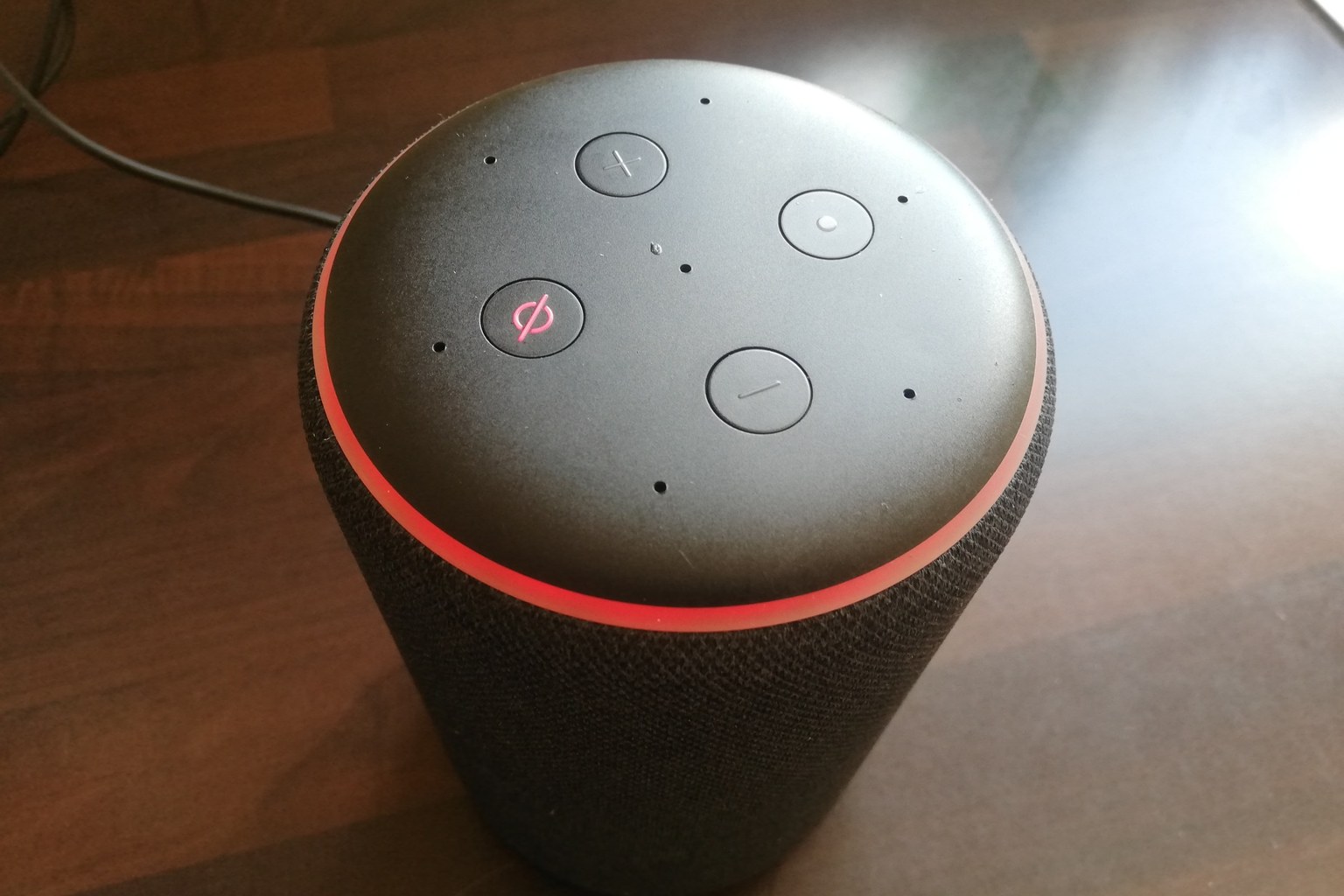
Header photo: Smart Home Perfected / Wikimedia Commons, CC BY 2.0
A device is "always listening" in three separate places, and only one of them is the cloud. There is the microphone and its converter, which are physically live whenever the product has power. There is a wake-word engine running on a low-power block that never fully sleeps. And there is a short buffer of audio that fills continuously so the first syllable of the wake word is not clipped. A buyer who asks only "do you upload my customers' voice" has asked about one of the three, and usually the one the factory is most comfortable answering. The other two decide what your privacy notice can honestly say.
This is not a hypothetical risk category any more. In the last three years the enforcement has moved from guidance to invoices: a US$25 million civil penalty against a voice assistant for keeping children's recordings, a US$5.8 million settlement against a camera maker for letting staff watch customer video, and — since 2 August 2026 — a transparency regime in the EU with fines that reach into eight figures. None of those cases turned on a company admitting it listened. They turned on what the product did by default and what the documentation claimed.
Here is the split between those two things, and the eight questions that close it.
Always listening is three systems, not one
The phrase collapses three different engineering decisions into one word, which is why two products with identical privacy claims can behave completely differently.
| Layer | What it does | When it is active | Who decides |
|---|---|---|---|
| Microphone and converter | Turns air pressure into digital samples | Whenever the device has power | Hardware team, via the bias circuit |
| Wake-word engine | Matches a keyword against a small model, on a low-power block | Always, at a few hundred microamps | Firmware team, via the model and its vendor |
| Pre-roll buffer | Holds the last second or two so the word is not clipped | Always, in RAM, overwritten continuously | Firmware team, via buffer length and destination |
| Streaming path | Sends audio or a transcript onward after a trigger | Only after the wake word or a button press | App and cloud team, via the data-flow design |
On the audio SoCs we quote, the always-on keyword block is specified in the hundreds of microamps. The moment the full path opens — converter, DSP, codec, radio — the draw jumps to several milliamps. That gap is not an accident of process; it is the whole reason a separate always-on domain exists. A product claiming 8 hours of playback and a month of standby is telling you, in the only units that cannot be fudged, that the wake-word block is cheap and the streaming path is switched off. It is also telling you the microphone is not off, because a microphone with no bias current cannot feed a keyword engine.
The audio is digital before it leaves the board
This is the detail that decides whether "mute" is a hardware promise or a software setting. Once the samples exist as numbers inside the product, any downstream behaviour — logging, buffering, transmitting — is a line of code, not a physical fact.
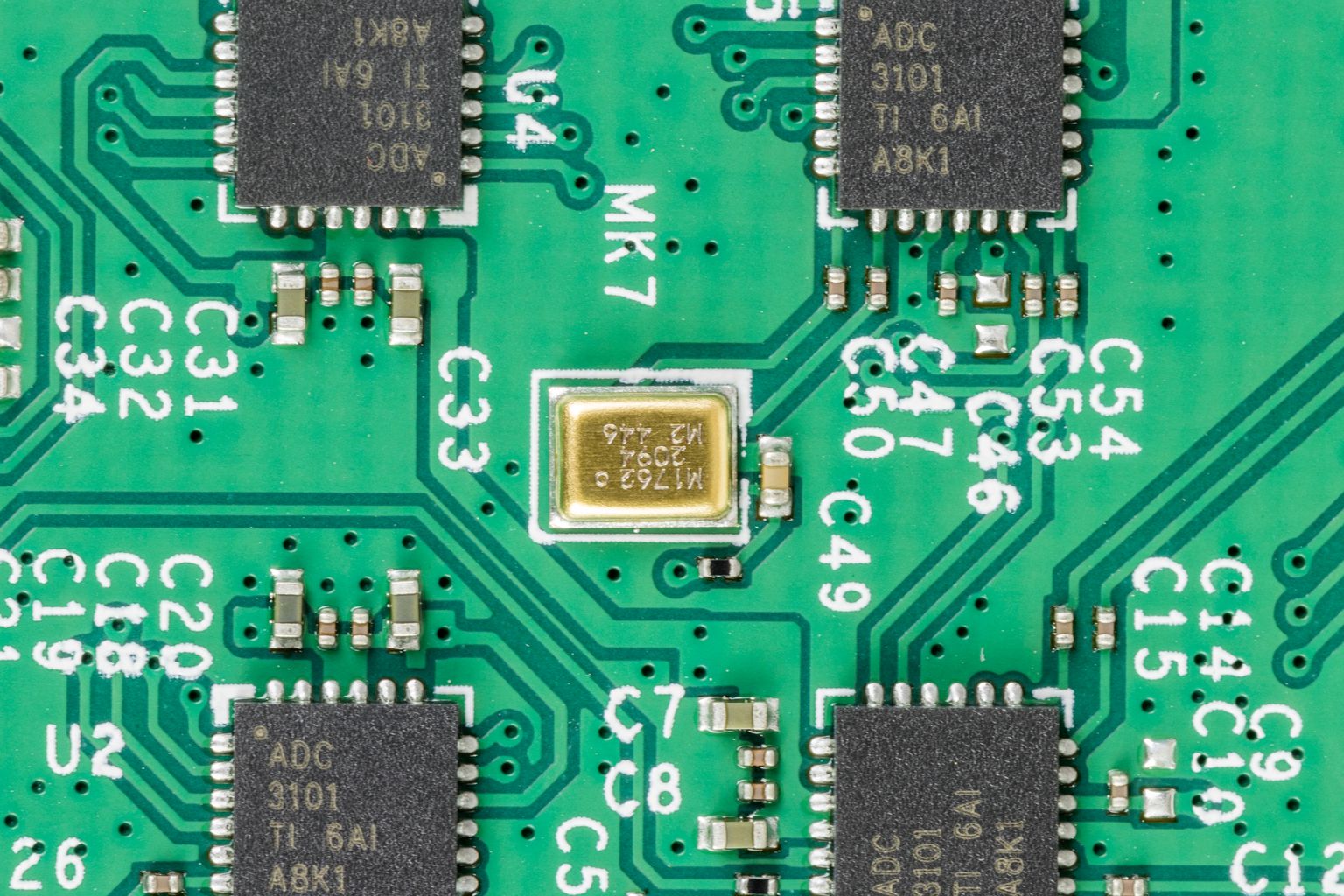
Count the channels in that photograph and you can work backwards to the array: four stereo parts give eight inputs, and a seven-microphone design uses seven of them with one spare for a reference or a diagnostic path. Multi-microphone arrays are not marketing — they are how a device hears you across a room at a reasonable false-trigger rate, and they are why the bill of materials for a "simple" voice feature includes four ICs instead of one.
It also explains why the same chip family can be specified as a budget part and a serious one. The converter does not care where the samples go next — the same eight channels feed a local command grammar in one design and a cloud transcript in another. We covered that fork in where the AI in earbuds and glasses actually runs; what matters here is that the fork is decided after the audio already exists as data.
The buyer-facing consequence is blunt. A factory that says "the microphone is off" and cannot show you the bias circuit is describing a register value. The register is real and the audio may genuinely stop reaching the application — but the converter is still clocked, the samples are still zeros, and anything with access to that data path can decide to send them somewhere. The two designs are not equivalent, and the difference costs roughly one switch.
A code mute and a copper mute are different products
A firmware mute writes zero gain into the converter or the DSP. The bias voltage stays on the microphone, the converter keeps running, and the output is a stream of very small numbers rather than silence. In practice that residue sits around -60 dBFS — audible if you amplify it, invisible in a spec sheet.
A hardware mute removes the microphone bias or grounds the data line. The converter has nothing to digitise, and no firmware path can put the signal back, because there is no signal.
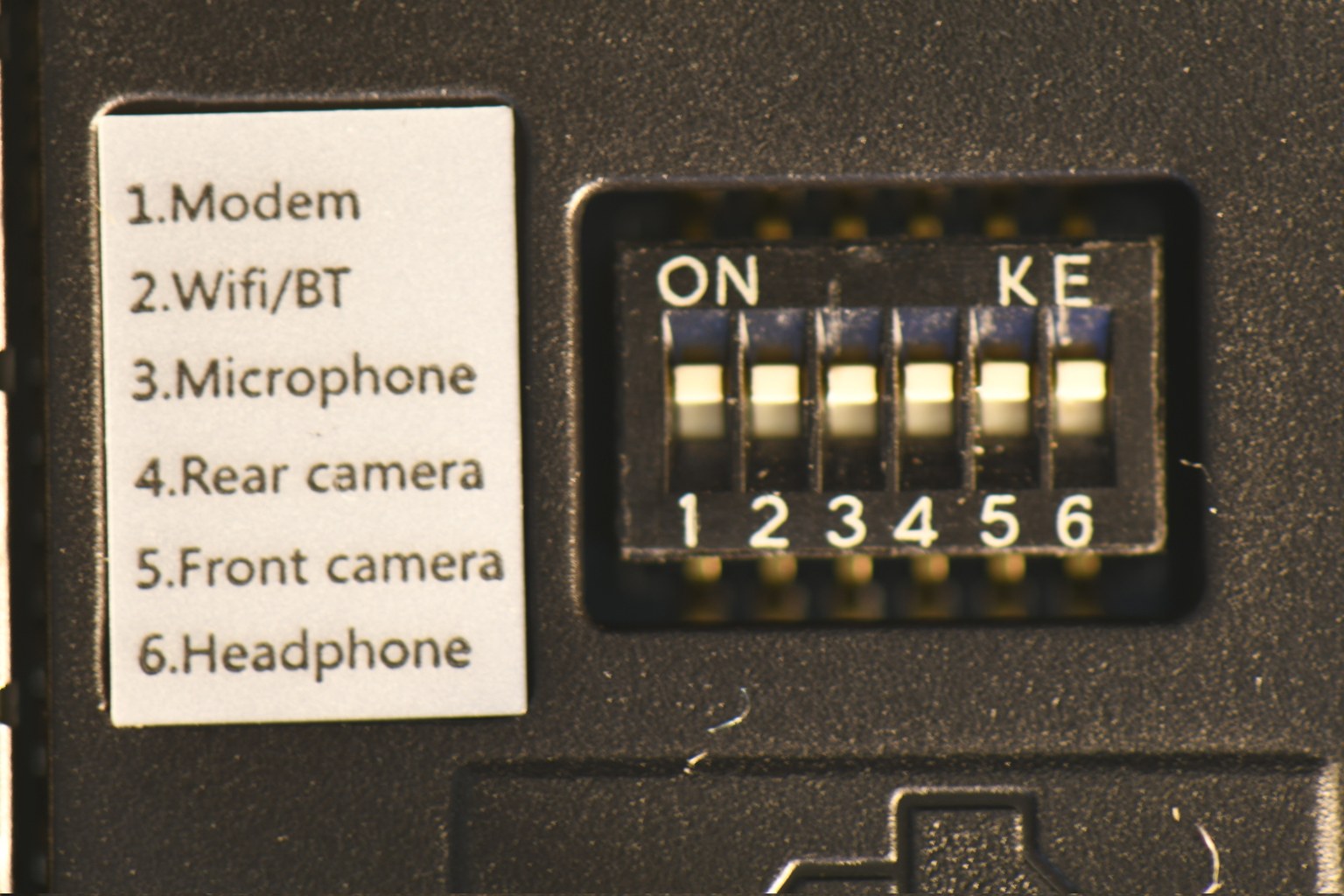
That photograph is a niche phone rather than a pair of earbuds, and the reason is honest: almost no audio product in our category ships with a mechanical mute, because the switch costs money and the marketing department cannot see it. In the bill of materials it is a slide switch, a small load switch or a bias-cut MOSFET, a cutout in the housing, and one more test step on the line. If the housing tool already exists, a slide insert for the cutout typically runs 5 to 7 days; if the cavity has to be recut, budget the tool again.
What surprises brands is not the cost. It is the conversation. On three projects we have asked a factory what happens to the microphone bias when the privacy button is pressed, and three times the first answer was "the software turns it off". The second answer, after the question was repeated with the schematic on the table, was that the bias stays on and the DSP gain goes to zero. Both answers were truthful. Only one of them survives being written into a privacy notice that a regulator can read.
There is a cheaper middle position that we recommend more often than a switch: an LED that is driven by the same GPIO that enables the bias. If the light is off, the microphone has no power, and the customer can check the claim with their eyes. It is not as strong as a mechanical switch, and it is far stronger than a menu toggle, because the indicator cannot be lit by software that has decided to listen anyway.
Where the audio goes decides who carries the liability
Four architectures cover nearly every product on the market, and they carry different obligations for the brand whose name is on the box. The mistake we see most often is a brand assuming that because the audio goes through a partner's cloud, the partner is responsible for the notice, the retention period and the deletion request.
| Architecture | What leaves the device | Who is the controller | What it costs you later |
|---|---|---|---|
| On-device only | Nothing; a fixed command grammar runs locally | Brand, with a very small data set | Lowest exposure, weakest feature set |
| Device to phone app | Audio or a transcript to the app, then to an ASR service | Brand for the app; the OS vendor sees its own telemetry | Two permission models to explain, in two languages |
| Device to own cloud | Audio clips, transcripts, account identifiers | Brand | A retention policy, a region, a DPIA, a breach clock |
| Device to third-party assistant | Audio to another company's service | Two controllers, one customer | You still have to disclose it, and you cannot see their retention |
The fourth row is where brands get caught out by their own product page. If an earbud can call a third-party assistant, the audio leaves your boundary, and the customer's reasonable assumption is that the brand whose logo is on the lid is the one holding the recording. In practice the transcript may live in a system you have no visibility into and no deletion interface for. The fix is not legal drafting. It is a data-flow diagram on one page, agreed before the app is built, listing every recipient by name and every retention period in days.
The numbers that turn a design choice into a legal one
Regulators do not ask whether a product is elegant. They ask how many days, how many hours, and how many euros. Five figures are worth having in front of you during the design review.
72 hours is the notification clock. Under Article 33 of the GDPR, a controller that becomes aware of a personal data breach must notify the supervisory authority within 72 hours, unless the breach is unlikely to result in a risk to individuals. A recording of a customer's living room that ends up in the wrong place is a personal data breach even if nothing was published, and the clock starts when you become aware — not when the investigation closes.
Article 35 is the reason a voice feature is not a normal feature. A data protection impact assessment is required where processing is likely to result in a high risk, and systematic monitoring of a publicly accessible area on a large scale is named as one of the triggers. A microphone in a pair of glasses worn into a shop is that trigger in a literal sense — the same form factor question we looked at in whether glasses replace translation earbuds, but answered by a regulator rather than by a product team. Retail deployments need the assessment before the pilot, not after the first complaint.
15 million euros or 3% of worldwide annual turnover is the ceiling under the EU AI Act for breaching the transparency obligations, and Article 50 has applied since 2 August 2026. The obligation itself is modest: a system that interacts directly with a person must make clear that the person is talking to an AI. Voice assistants are the textbook case. There is a grace period until 2 December 2026 for the machine-readable marking of generative output placed on the market before the cut-off, but the disclosure duties have no grace period at all.
1,000 dollars and 5,000 dollars are the two US figures worth knowing, per violation, under Illinois' biometric privacy law: the lower figure for negligent handling, the higher for intentional or reckless. A 2024 amendment limits recovery to one per person rather than one per scan, which turned a bankrupting exposure into a large one. Voiceprints are biometric identifiers under that statute, and the private right of action is the part that makes it expensive rather than theoretical.
5,000 dollars also appears in California, under a different theory. Recording a confidential communication without the consent of all parties carries statutory damages of US$5,000 per violation. A wearable that records continuously in a two-party-consent state is not doing anything unusual technically. It is doing something unusual legally.
The asymmetric information here is about categories. Raw audio is personal data. A voiceprint used to identify a specific person is special-category biometric data under Article 9, with a much narrower legal basis. The day a firmware update adds speaker identification so the assistant can recognise the owner, the product changes legal category — and that update is normally written by an app team, months after the privacy notice was signed and long after the packaging went to print. If the roadmap contains speaker ID, the data-flow diagram has to describe it now.
How to test a mute claim without a laboratory
Three checks, none of which needs an accredited lab, and all of which a brand can run on the first sample.
Measure the current. Put a microamp meter in the supply and toggle the mute. A hardware cut drops the microphone bias, which is typically a few hundred microamps and visible on any bench meter. A firmware mute changes the current by almost nothing, because the converter is still converting.
Record while muted. Park the device in a quiet room, play a 1 kHz tone at 94 dB SPL — the standard reference level, roughly a loud meeting — and record through the app with mute engaged. A firmware mute leaves residue around -60 dBFS, which shows as a visible band on a spectrogram. A hardware cut leaves the converter's own noise floor and nothing else.
Cut the radio and watch the link. A shielded pouch makes the question concrete: with the device inside, does the app lose the device, and does it come back?
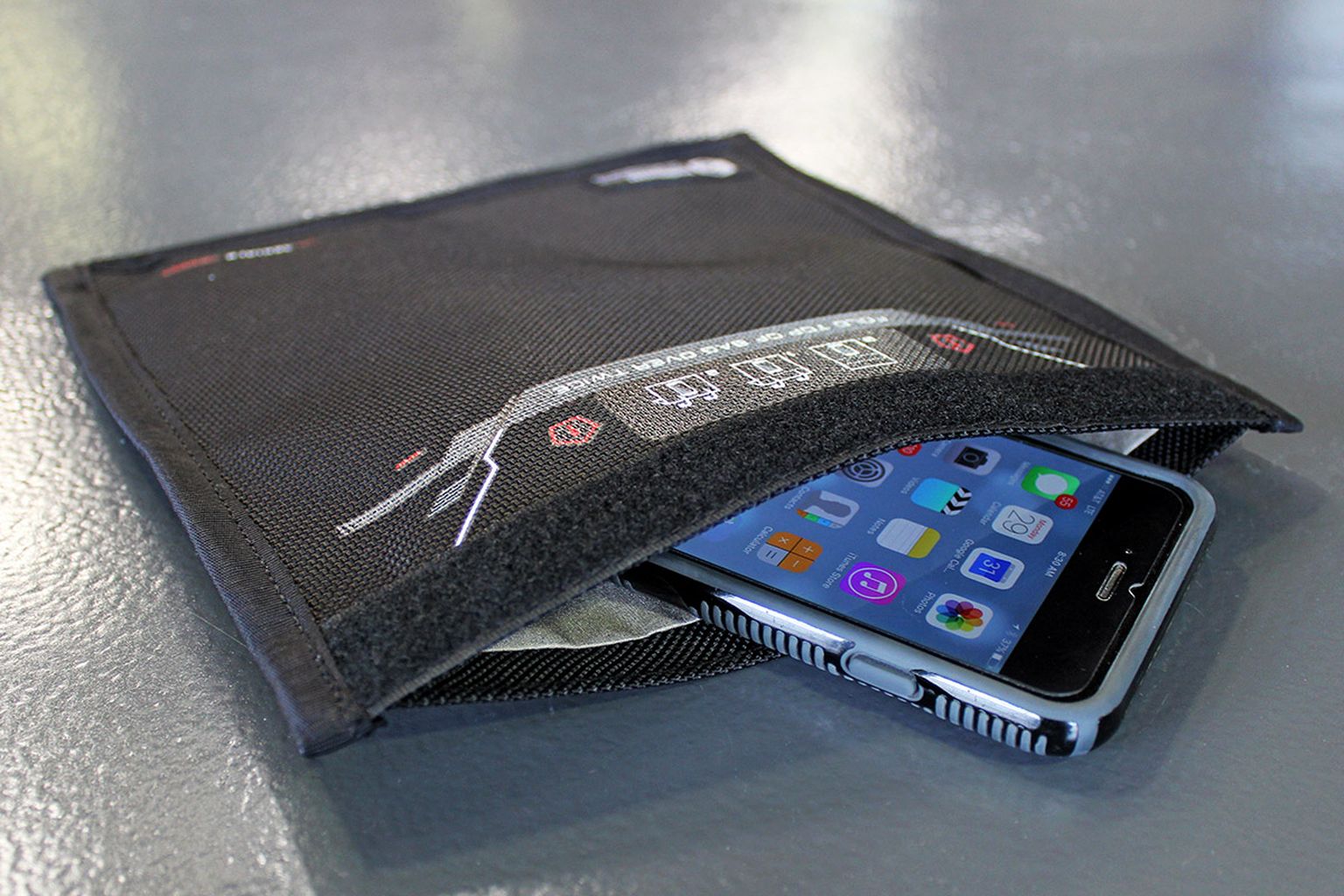
The pouch also answers a question nobody asks in the design review: what happens to the audio when the network is gone? A device that buffers to flash and uploads later is doing something defensible and something risky at the same time — defensible because the feature keeps working, risky because the recording now sits on a device the customer can lose. A device that drops the audio is simpler and has less to explain. Either is a choice. Neither is a default you should discover during a support call.
Budget 15 minutes per unit and run it on 5 pcs from the lot, not on the golden sample from the sales meeting. We have seen a mute that worked perfectly on the engineering build and did nothing on production firmware, because the test-mode branch that disabled the audio path had been compiled out for the release build.
Eight questions to put in the RFQ
These belong in the RFQ document, with the quotation marked incomplete without them. An email answer is not a specification; it is a memory of a conversation between two people who may both have moved on by the time the goods ship.
1. Microphone topology. How many microphones, what type, where they sit on the mechanical drawing, and how many converter channels they occupy. Ask for the schematic page for the bias circuit, not the block diagram.
2. Wake-word engine. Which vendor's model, which block it runs on, what its idle current is in microamps, and what happens to the false-trigger rate when the model is retrained for a new language.
3. Pre-roll buffer. How many seconds it holds, whether it lives in RAM or flash, and whether it is cleared on power loss or on a mute event. This is the question that separates "we do not store audio" from "we store a second and a half of it, always".
4. Mute implementation. Bias cut, data-line cut, or DSP gain. Which GPIO drives it, whether the same GPIO drives the indicator LED, and whether any firmware path can re-enable the audio while the switch is in the muted position.
5. Data-flow diagram. One page, every recipient named, every protocol named, including analytics SDKs in the app that nobody on the hardware side has heard of.
6. Retention. Audio and transcript separately, in days, with the default stated rather than the maximum. Ask what a deletion request does to a backup, and how long the backup takes to age out.
7. Hosting and sub-processors. Cloud region, the list of sub-processors, and whether a customer can be pinned to a region. An EU customer asking where the audio is stored deserves an answer with a country in it.
8. Update authority. Who signs firmware, whether an OTA update can add a new listening mode without a hardware change, and how a customer can refuse that update. A microphone whose behaviour can be extended remotely is a different product from one whose behaviour is fixed at the factory, and the customer is entitled to know which they bought.
If you only get one of the eight before the tool is cut, take the fourth. Questions 1 to 3 describe a design and can be changed at the next revision. Question 4 is the one that decides whether your privacy claim is a fact or a promise, and it is the only one that a customer can verify with a screwdriver.
What this costs at 1,000 pcs and at 3,000 pcs
Privacy features are usually budgeted as if they scale with the bill of materials, and mostly they do not. The switch, the MOSFET and the extra test step scale with units. The schematic review, the data-flow diagram, the privacy notice and the impact assessment do not — they are fixed costs paid once, and they get cheaper per unit as the order grows.
That asymmetry matters when a brand is choosing between 1,000 pcs and 3,000 pcs. The compliance work is already sunk at the smaller quantity. The marginal cost of doing it properly is a few days of engineering and a paragraph in the manual; the marginal cost of retrofitting it after the housing tool exists is a tool revision, a re-certification of the radio if the switch changes the enclosure — the marks on the label are covered in which certifications a product actually needs — and a new round of documentation in every language you sell in. On a 1,000 pcs order the fixed cost dominates. On a 3,000 pcs order the switch dominates, and it is still the smaller number.
The other cost is time. A privacy review that starts before the mechanical design freeze takes about a week. The same review started after the pilot run takes as long as the tool revision does, which is 20 to 35 days on a typical housing, and it lands on the launch date rather than on the design calendar.
Our stance
Do not accept "we do not record" as an answer to a question about a product with a wake word. It is almost always true about the cloud, frequently false about the buffer, and never a complete description of the audio path. Ask for the buffer length in seconds and the mute implementation in circuit terms, and the sentence either becomes verifiable or it disappears.
Do not let a firmware mute stand in for a hardware mute in anything you describe as private. If the product has a menu toggle, call it a menu toggle. The gap between the two is the gap between a claim you can defend and a claim you have to explain.
Do not ship speaker identification as a firmware update. It changes the legal category of the data, it changes what the notice has to say, and it changes what happens in a breach. If the roadmap includes it, put it in the first data-flow diagram and price it into the first certification, even if the feature arrives in year two.
And do not treat this as a document problem. The document follows the design. A privacy notice written before the schematic is reviewed is a description of what somebody hoped the product would do — and in the cases that ended in eight-figure penalties, that is exactly what it turned out to be.
Reviewing a voice feature before tooling?
We are a sourcing and OEM partner in Shenzhen, working across wireless audio, smart glasses and wearables. Send us the microphone section of the schematic and the data-flow you were given, and we will tell you which parts of the privacy claim the hardware actually supports — and what changes at 1,000 pcs and at 3,000 pcs.
See how we run an OEM project →