
From boombox to party speaker: how portable speakers got loud again — and what a buyer should check before sourcing one
The 1980s boombox was a mechanical argument: more drivers, more batteries, more kilograms. The Bluetooth speaker that replaced it was an electrical one: a class D amplifier, a sealed box with a passive radiator, and a phone as the source. The party speaker that came back in 2017 is the first category in 40 years that sells loudness again — which is exactly why its specification sheet is the hardest one to read.
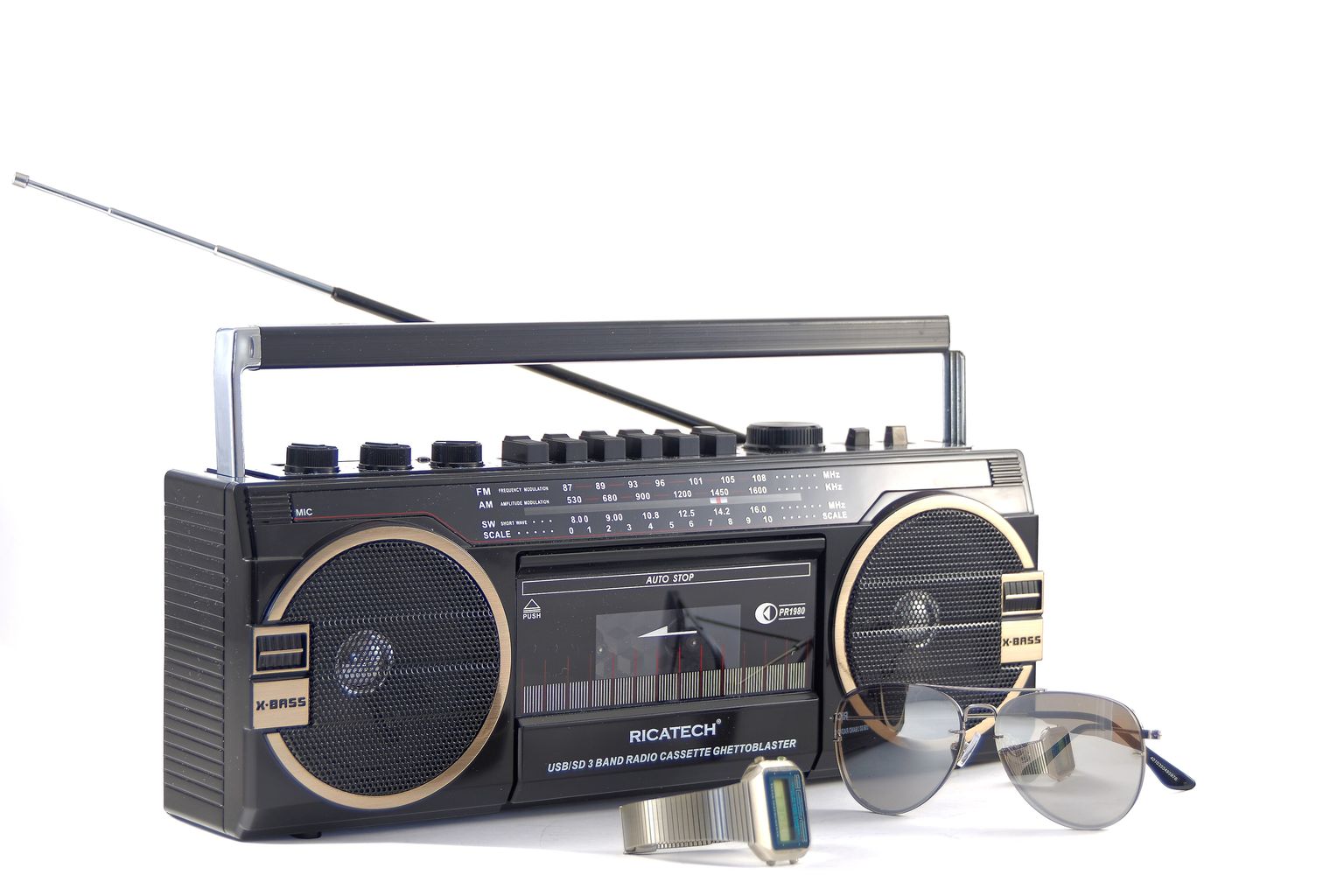
Header photo: VSchagow / Wikimedia Commons, CC BY-SA 4.0
Portable speakers did not evolve in a straight line. They went from 12 kg of plastic and ten D-cells, to a 340 g brick you could put in a jacket pocket, and then back up to a 27.8 kg box with wheels. Each move was driven by the same three components — amplifier efficiency, battery energy density, and where the music comes from — and each one changed what the specification sheet means. If you are sourcing a speaker this year, the useful question is not "which generation is this" but "which of these three numbers is the factory actually quoting".
We have quoted speakers in three of those eras, and the same argument shows up every time. A buyer sends a competitor's spec sheet with "800 W" on it, the factory quotes 120 W, and everyone spends a week arguing about price when the real disagreement is about what the word "watt" is doing on the page.
Here is the history, and here is how to read the numbers at the end of it.
1981: the arms race was mechanical, not electrical
The Sharp GF-777 is the reference point for a reason. Six speakers — two 16 cm super woofers, two 16 cm mid woofers, two horn tweeters — driven by four separate amplifiers, in a cabinet measuring 752 by 166 by 379 mm. It weighed 12.2 kg before you put the batteries in, and it took ten D-cells to run. The Henry Ford museum, which holds one, describes it as weighing thirty pounds minus the batteries, and notes that it appeared on the back cover of Run-DMC's first album.
That machine is the whole 1980s category in one object. The claimed output was 90 W PMPO. Read that number the way it was written: peak music power output, a marketing convention that measured a transient, not a continuous signal. What actually came out of the cabinet, driven by four small amplifiers running off 15 V of D-cells, was a fraction of that. Nobody minded, because the thing was loud enough for a street corner and the specifications were not the product. The object was.
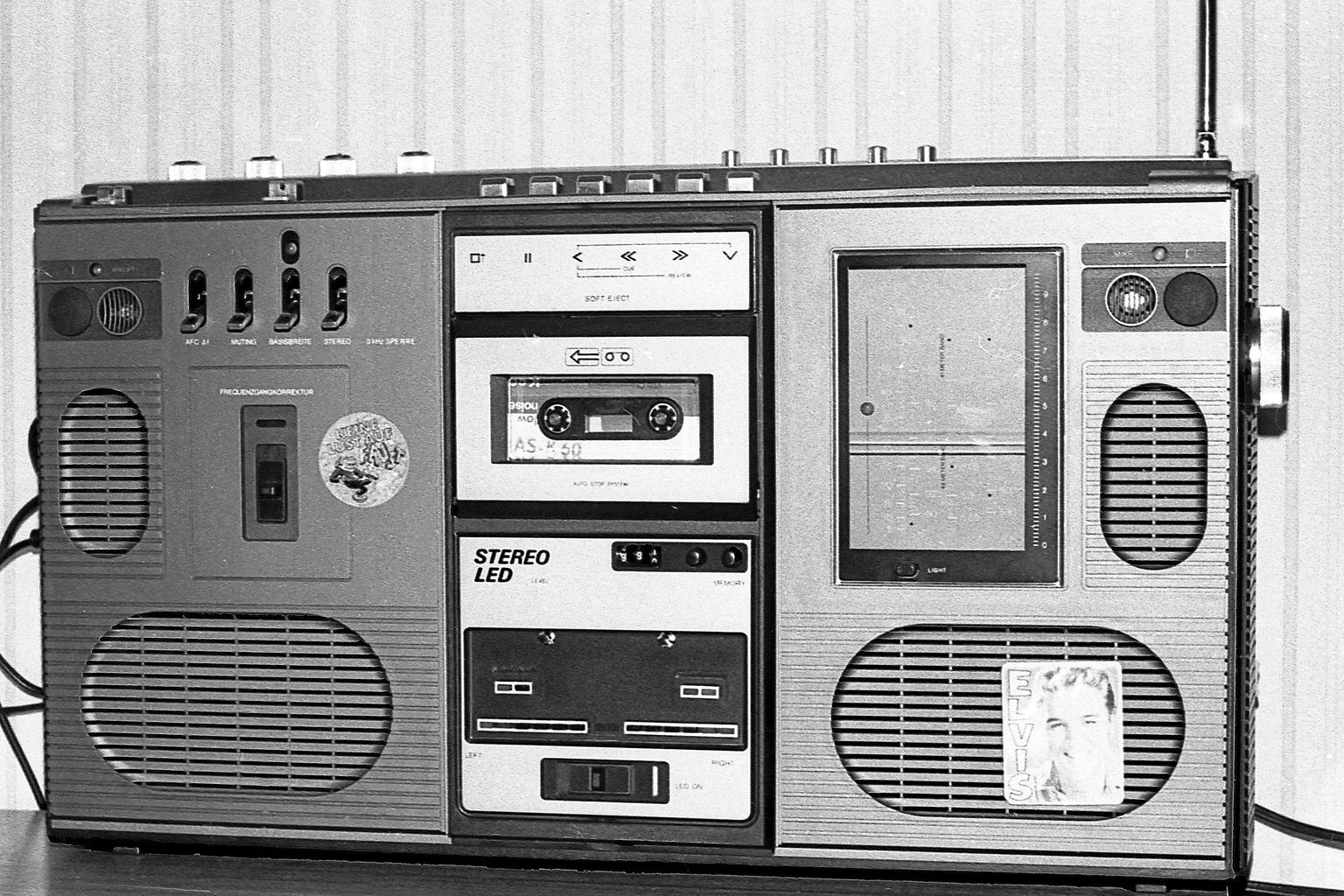
Three things made that design inevitable. Amplifiers of the period were class AB, which turns something like half of its input power into heat, so a genuinely loud portable needed a large heatsink and a large battery. Bass needed cabinet volume, and cabinet volume needed a bigger box. And the source was physical media inside the box, so the box had to hold a tape transport, a tuner and a power supply as well. The 12 kg was not laziness. It was the physics of 1981, plus a cassette deck.
1990 to 2009: the box shrank, but the sound got worse
The generation that grew up between the boombox and the Bluetooth speaker is usually skipped in these histories, and it matters for one reason: it is the period when portable audio stopped being a shared object. The source moved into a pocket. The speaker became either a dock the phone sat in, or a pair of earbuds. A dock is not portable in any meaningful sense — it needs a wall socket, and it needs the phone to stay attached to it — so for about 15 years the category had no answer to "loud, outdoors, no cable".
What filled that gap was a class of cheap battery speakers with 2 W amplifiers and a 3.5 mm jack. They were the reason "portable speaker" sounded like a compromise. Buyers of that era learned to expect distortion at half volume, and the factories learned that the category would tolerate it. Both habits survived into the Bluetooth era and still cost money today.
2010: the phone becomes the source, and the box falls under half a kilo
The Jawbone Jambox, announced on 4 November 2010 at $199, is the inflection point most histories agree on. It weighed 12 oz, about 340 g. It had two drivers, a passive bass radiator and a sealed enclosure, and it connected over Bluetooth instead of a cable. Nothing in it was new physics. What was new was the combination: a class D amplifier small enough to fit in a rubber-wrapped brick, a lithium pack dense enough to run it for hours, and a phone in every pocket holding the music.
That last part is the piece buyers underestimate. Once the source is a phone, the speaker no longer needs a transport, a tuner, or a display. It needs a radio, an amplifier, a battery and a box. The mechanical argument of 1981 disappears, and the design argument starts. The Jambox is a good marker because it is honest about it: the whole product is a sealed volume with two drivers and a moving-wall radiator, and the industrial design is doing as much work as the acoustics.
2013: the sealed tube, and the first spec sheet worth comparing
Three years later the shape settled into the cylinder that is still the default. The UE Boom launched in May 2013 at $199.99 with a specification sheet that reads like it was written by engineers rather than by marketing: maximum sound level 88 dBA, frequency range 90 Hz to 20 kHz, two 1.5-inch 4 ohm drivers and two 2-inch passive radiators, 15 hours of playback, a range of 15 m, and a weight of 1.2 lb. In the same season JBL's Flip was selling at $99.99 and its Charge at $149.99.
Note what happened to the numbers. The 1981 boombox led with a peak wattage. The 2013 tube led with a sound pressure level, a frequency range and a playtime. That is a category growing up: it stopped quoting the size of the engine and started quoting what came out of the box.
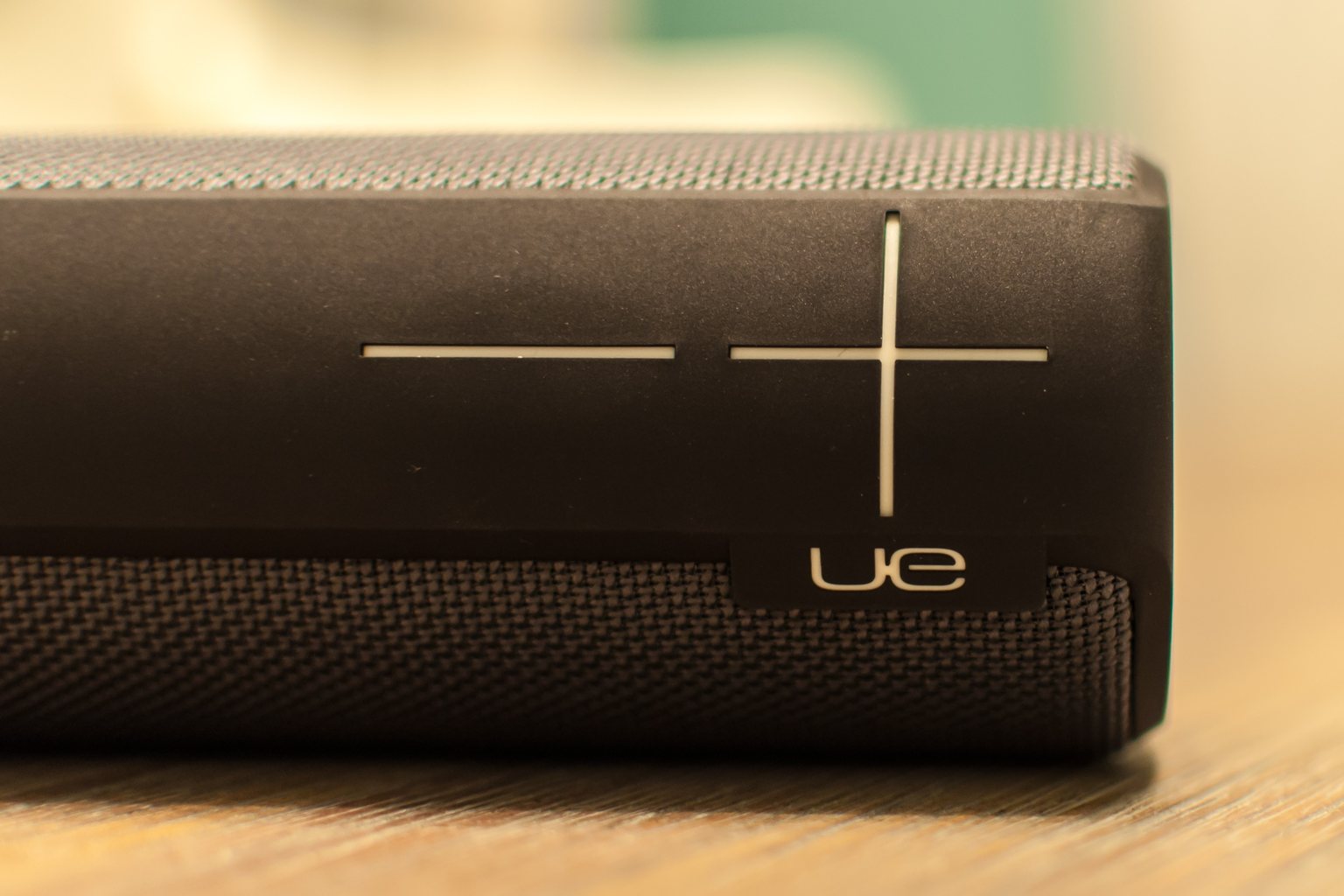
The passive radiator is the part of this design that buyers rarely ask about and should. A small sealed box cannot produce low bass without one, because a 1.5-inch driver cannot move enough air. A passive radiator is a diaphragm with no motor — the driver's back pressure moves it, and it extends the low end by roughly half an octave in a box that would otherwise sound thin. It also means the tuning is a physical property of the box: change the radiator's mass, its compliance, or the internal volume by a few cubic centimetres, and the bass response moves. A factory that swaps a radiator "to save cost" is changing the product, whether or not the model number changes.
2017 onward: the category splits in two, and one half goes back to 1981
For about five years the market moved in one direction — smaller, cheaper, more waterproof. Then it split. One branch kept shrinking into things that clip to a backpack. The other branch went the other way, and it is the more interesting story for anyone sourcing today, because it brought back the boombox's actual proposition: a box you carry to a place where people are, and make loud.
| 1981 boombox | 2013 pocket speaker | 2026 party speaker | |
|---|---|---|---|
| Example | Sharp GF-777 | UE Boom | Soundboks 4 |
| Weight | 12.2 kg, plus 10 D-cells | 540 g | 16.1 kg |
| Power | 90 W PMPO, four amplifiers | Not published as a wattage | 3 × 72 W RMS class D |
| Battery | 10 × D-cell, disposable | Rechargeable, 15 hours claimed | 99.84 Wh LiFePO4, 6 hours at full volume |
| Claimed loudness | Not stated | 88 dBA maximum | 126 dB maximum SPL |
| Source | Tape, radio, microphone | Phone over Bluetooth | Phone, plus XLR and instrument inputs |
The party speaker is where the money is now, and it is also where the specification sheets have become creative again. A JBL PartyBox 710 is rated 800 W RMS to IEC 60268, with two 216 mm woofers and two 70 mm tweeters, a response of 35 Hz to 20 kHz at minus 6 dB, and a net weight of 27.8 kg. It has no battery; it runs on mains. A Soundboks 4 takes the opposite approach: 3 × 72 W RMS of class D, a claimed maximum of 126 dB, a 99.84 Wh lithium iron phosphate pack, 16.1 kg, and a playtime quoted as 40 hours at mid volume against 6 hours at full volume.
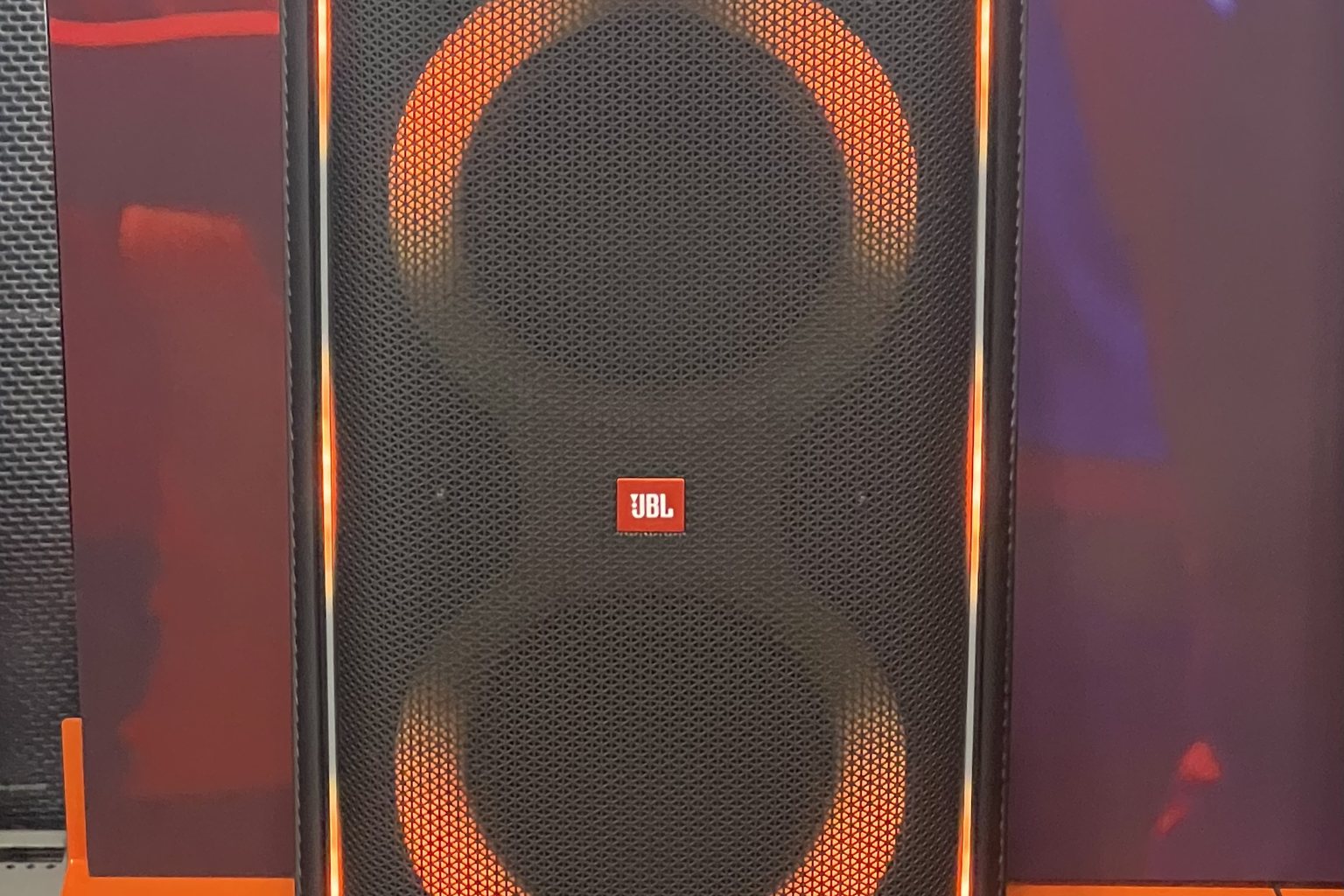
Put the Soundboks numbers side by side and a buyer learns more than any marketing page will tell them. One battery, one amplifier bank, two playtime figures that differ by a factor of roughly 6.7. Both are true. They describe two different listening levels, and the difference between them is the whole economics of the category: loudness costs energy, and energy is the heaviest, most expensive and most regulated part of the product.
What actually changed inside
Four components did the work, and all four are still moving.
The amplifier class. Class D switches instead of amplifying linearly, which puts something like 80% to 90% of the input into the speaker rather than into heat. That single change is why a 16 kg box can produce 126 dB on a battery, and why the 12 kg boombox needed a heatsink and a mains lead to do far less.
Digital signal processing. A modern speaker does not send a flat signal to its driver. It applies a limiter that stops the woofer from exceeding its excursion, a bass shelf that compensates for the small cabinet, and often a dynamic EQ that changes with volume so the speaker sounds the same at low levels. This is also the part buyers do not budget for: the DSP is firmware, the tuning is a set of coefficients, and the coefficients belong to whoever wrote them.
The battery chemistry. Lithium iron phosphate, as used in the Soundboks pack, trades a little energy density for cycle life and thermal stability. That is a deliberate choice for a product that will be charged 300 times and left in a hot car. Cheaper products use a standard lithium-ion pouch or 18650 cells, which is fine — but the certification path is different and the paperwork is not optional.
The radio. Bluetooth 5.x with a class 2 radio is a 10 m class link in free air, less through a wall or a human body. Every manufacturer quotes the free-air number. Every user experiences the other one. If a product claims 30 m, ask whether that was measured with a clear line of sight, and be aware that the antenna placement inside a metal-grilled cabinet decides more than the chip does. Codec choice matters less at this distance than people think; we covered that separately in the codec piece.
The three numbers that decide price, returns and freight
Almost every argument about a speaker quotation comes down to three numbers, and each one is quoted in a way that makes comparison hard.
1. Wattage. PMPO is a peak figure that can be several times the continuous rating, and it survives because it is legal and because retail packaging likes big numbers. RMS to a named standard such as IEC 60268 is a measurement with a defined bandwidth and a defined distortion limit. If a sheet says "800 W" with no standard and no distortion figure, treat it as a peak number until proven otherwise. This is the same discipline we described in reading a factory quotation: the number is meaningless without the conditions printed next to it.
2. Loudness. Decibels are logarithmic, which has a practical consequence: an increase of 10 dB is ten times the acoustic power, and roughly twice as loud to a listener. Three more dB is double the power. So a speaker that claims 6 dB more than another is claiming four times the amplifier power and about four times the battery draw for a difference a listener hears as "louder" but not dramatic. When a factory promises 126 dB from a 100 Wh pack, the honest follow-up is "for how many minutes, at what distortion".
3. Playtime. This is where the two Soundboks figures earn their place. Forty hours and 6 hours come from the same 99.84 Wh pack. The variable is output level, and the relationship is not linear — each 3 dB of extra output doubles the electrical power, so the last few clicks of the volume dial eat the battery. A playtime claim without a stated level is not a specification; it is a best case.
There is a fourth number that buyers compare badly, and it is worth a paragraph on its own: battery capacity. Amp-hours are only meaningful with a voltage attached. A pack rated 5,000 mAh at 3.7 V holds 18.5 Wh. The Soundboks pack is rated 7.8 Ah — a smaller-looking number — but at 12.8 V it holds 99.84 Wh, more than five times the energy. Always convert to watt-hours before you compare two products, and always ask whether the quoted figure is the cell capacity or the usable capacity after the protection board's cut-off.
What this means for a buyer: eight lines for the RFQ
This is the part that turns the history into a purchase order. Send these eight as a numbered list and ask for numbered answers. A factory that can answer all eight has an engineering function. A factory that answers four in adjectives and four with "standard" does not, and you have learned that before paying for a tool.
1. Rated output in watts RMS, to which standard, at what distortion, over what frequency band? If the answer is a peak figure, you are negotiating a different product from the one you think you are buying.
2. Maximum SPL at 1 m, and the distortion at that level? Ask for the test condition as well: pink noise or music, one speaker or two, indoors or out.
3. Battery energy in watt-hours, usable after cut-off, and playtime at a stated SPL? Not amp-hours. And ask what the standby drain is, because a speaker that loses 5% a week in a drawer generates returns that never show up in a lab test.
4. Amplifier class, channel count, and where the heat goes? A sealed plastic cabinet with no thermal path will derate itself after 40 minutes at high output. Ask what the limiter does when the heatsink reaches its limit.
5. Driver part numbers, passive radiator tuning, and cabinet wall thickness? This is the line that separates a real design from an assembly of whatever was in stock. A 2.0 mm wall with no ribbing will buzz at high SPL, and the customer hears it as "defective", not "budget".
6. Which parts carry the IP rating, and to which test? IPX4 is splashing water; IPX7 is immersion at 1 m for 30 minutes under IEC 60529. The rating applies to the assembly as tested, and the charging-port cover is the component that fails first in the field.
7. Drop test standard, carton specification, and gross weight per carton? A 27.8 kg unit ships in a 31 kg carton. On a party speaker, freight per unit can be a larger line than the electronics, and the carton is what decides the damage rate. ISTA 1A is the usual entry point, and the on-floor version of this check is in the pre-shipment checklist.
8. Firmware: who owns the source, how are updates delivered, and what happens if we change supplier? If the DSP coefficients, the app and the pairing behaviour live on the factory's laptop with no escrow, then your product's future is rented. This is the same ownership question as tooling, and it belongs in writing before the first purchase order.
Our stance
Do not buy a speaker on a peak wattage. It is the one number in the category that has been unreliable for 45 years, and the factories know which buyers still fall for it.
Do not accept a playtime figure without a stated level, and do not compare amp-hours across products with different pack voltages. Both mistakes are common, both are cheap to avoid, and both cost real money at the returns desk.
Do not specify a sealed cabinet without a tuning report. The passive radiator is where the bass comes from, and it is also where a cost reduction quietly changes the sound. If a factory cannot show you the tuning frequency and the driver model, it has not designed the box; it has copied one.
We would rather sell a 20 W speaker with an honest sheet than an 80 W speaker with a marketing number, because the second one comes back. The first one gets reordered.
Sourcing a Bluetooth or party speaker?
We are a sourcing and OEM partner in Shenzhen, working across wireless audio, smart glasses and wearables. Send us the spec sheet you are being quoted against and we will tell you which numbers are measured, which are peak figures, and what the same product should cost at 1,000 pcs and 3,000 pcs.
See our Bluetooth speaker range →