
Pre-shipment inspection checklist: what to check on the floor before you wire the balance
Eight checks, in the order they have to happen, for the buyer who is standing in the factory rather than reading a PDF afterwards. What to count, what to scan, which carton to drop and from what height, and the two documents that stop a container at the airport regardless of how good the report looks.
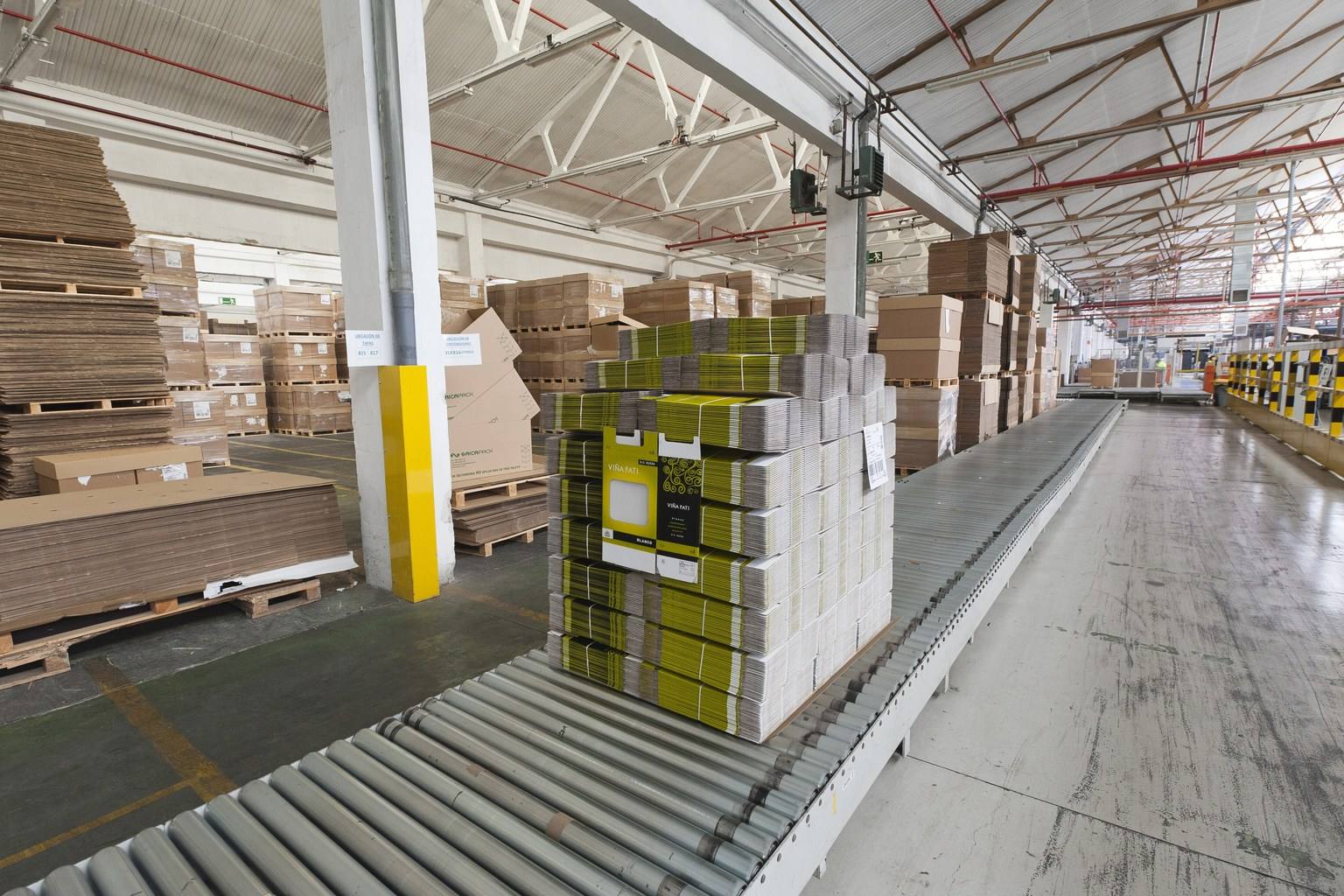
Header photo: SimónK / Wikimedia Commons, CC BY-SA 4.0
A pre-shipment inspection is a day of work, not a document. You count the cartons before anyone opens one, read the marks printed on the outside, scan the barcode with a real scanner, look at the product under the light your customer will use, run the function test on the factory's jig and then on your own, open a carton and pack it back, drop one carton from a stated height, and check the battery paperwork. Do those eight things in that order and a pass means something. Do them out of order — product first, cartons last — and you will finish the day having inspected the only part of the shipment that was never at risk, because by then the cartons are sealed and the count is whatever the factory told you.
The reason the order matters is that each check destroys the evidence for the next one. Open a carton and you can no longer weigh it as packed. Repack it and you can no longer see how it left the line. Seal a pallet and the marks on the bottom cartons are gone for good. An inspector who starts with the product and works backwards is doing a quality check; an inspector who starts with the pallet is doing a shipment check. On consumer electronics, the shipment is where the money is lost.
This is the floor-side half of the subject. The other half — how to read the report afterwards, what the verdict line actually proves, why a certificate is not a report — is in the DUPRO and PSI article. Read that one before you book; read this one on the morning you travel.
The day has an order, and most inspections get it wrong
A normal single-SKU order takes one man-day on site, roughly 6 hours of actual work. Here is how that time should split, and how it usually does not.
| Stage | Time | What it settles |
|---|---|---|
| Lot identity against your PO | 30 minutes | That this is your order, this model, this quantity, today |
| Carton count, weight, marks | 45 minutes | Whether the quantity exists and whether it can be delivered |
| Drawing the sample | 20 minutes | Whether the sample is random or offered |
| Appearance | 90 minutes | Whether the finish matches the signed sample |
| Function | 60 to 90 minutes | Whether the units work, and against which firmware |
| Pack-out and repack | 45 minutes | Whether the customer receives what you approved |
| Drop test | 30 minutes | Whether the carton survives the last mile |
| Close-out | 30 minutes | What is written down, what is held, who signs |
Three of those eight stages are about packaging, and packaging is where the day is usually cut short. Inspectors who arrive at 10 a.m. and leave at 3 p.m. spend the time on the product, because that is what the buyer asked about in the emails. The carton gets a glance.
That is backwards. On a consumer audio shipment, the units almost always work — the line tested every one of them. The cartons are the part that fails: a missing country of origin, a barcode that will not scan at the retailer's inbound dock, an inner tray that crushes at the bottom of a pallet. None of those are quality defects and all of them can stop a delivery.
Check 1 — Count cartons, not pieces
Count the master cartons on the floor and multiply by the pieces per carton. That number has to equal the packing list, and the packing list has to equal the purchase order. Three numbers, one of them usually wrong.
Then weigh. Take one carton from each pallet position — not the top of the stack, which is the one they prepared — and put it on a scale. Compare the reading with the gross weight printed on the packing list. A carton that comes in 300 g light on a 12 kg gross is not a rounding error; it is 2.5%, and on a carton of small earbuds it is usually one inner box short. Weighing is the fastest quantity check there is, and almost nobody does it, because counting feels more rigorous and takes longer.
Then check the inner structure. If the carton is specified as 10 inner boxes of 6 units, open one and confirm 10 by 6. Factories substitute inner counts when a tray runs out — 12 by 5 fills the same carton and passes the same total. Your retailer's shelf pack does not care about the total. It cares about 6.
One more number worth writing into the order: the tolerance. "Short shipment not accepted" is not a clause, it is a wish. "Carton count to match the packing list within 0 pcs, and any shortfall to be credited at unit price on the final invoice" is a clause. On a mixed order, expect the factory to be short on the colour that was hardest to make and long on the one that was easiest. Count by colour, not just by total. The pieces-per-carton figure itself is set at quotation stage, which is what a MOQ of 1000 actually includes — the packing configuration is part of what you agreed, not a detail the line decides later.
Check 2 — Read the carton before you open it
Everything printed on the outside of a master carton falls into three groups, and a carton that is missing any of them is a carton that will be handled by someone guessing.
Identification marks: the consignee reference or buyer mark, your PO number, the item code, the carton number as "7 of 24", and the destination port. The carton numbering is the one to look at closely. If all 24 cartons say "1 of 24", the number was printed as a block and nobody counted anything — which tells you the packing list was assembled from an assumption rather than from the pallet in front of you.
Information marks: country of origin in English and permanent, gross and net weight, and external dimensions in centimetres. Origin marking is not decoration. US Customs requires the English name of the country of origin to be legible and permanent on the article or its container, and a carton that says only "China" rather than "Made in China" is a conversation at the port rather than at the factory.
Handling marks: the pictograms from ISO 780 — the broken glass, the two arrows, the umbrella, the stacking limit. The recommended height for normal packages is 100, 150 or 200 mm, printed in black on a light background, and the fragile symbol belongs in the upper left corner of all four upright sides. A carton with one small glass symbol on one face has a mark that will never be seen by the person who needs it.

If the goods sit on wooden pallets, look for the ISPM 15 stamp: the IPPC wheat logo, the country code, the producer code and either HT or MB for the treatment. A pallet without it can be refused, fumigated or destroyed at destination, and the cost lands on the importer, which is you. This is a 10-second check per pallet and it is skipped on almost every inspection because it is boring.
Check 3 — Scan the barcode, do not look at it
Two different codes are involved and they are frequently confused. The retail unit carries an EAN-13. The shipping carton carries an ITF-14 built from the same GTIN with a pack indicator. A factory that prints only the EAN-13 on the unit and nothing on the case has made the warehouse count every box by hand.
For the unit code, the numbers that matter are in the GS1 specification, not in opinion. The nominal module width is 0.330 mm at 100%, and the permitted range is 80% to 200%, so 0.264 mm to 0.660 mm. The quiet zone is 11 modules on the left and 7 on the right, and artwork that creeps into it turns a valid symbol into an unscannable one. Minimum print quality is grade 1.5 under ISO/IEC 15416, measured with a 6-mil aperture and 660 nm light — written as 1.5/06/660.
Then scan it. A real handheld scanner, on the packed carton, at the angle a picker uses, ten times in a row. A symbol that scans on a flat proof and fails on a curved or glossy pack is the normal failure, not the exception. And check the colour: bars printed in red, orange or a warm tint are invisible to a 660 nm scanner. We have seen a brand print its logo colour straight through the barcode panel because the artwork looked better that way. It scanned on the designer's monitor and nowhere else.
The asymmetric part: a GTIN that was bought from a reseller rather than issued under your own GS1 company prefix will scan and will fail the retailer's registry lookup. That check happens weeks after the goods arrive, when reprinting 24,000 packs is the only fix. Ask for the GS1 prefix certificate before the first print run, not after the first chargeback.
Check 4 — Judge appearance in the light your customer will use
Factory floors are lit for production, not for judging finish: high-pressure sodium, greenish, and flattering to everything. A housing that looks clean under it can look grey next to a white retail pack.
Ask for a neutral lamp of 4000 to 5000 K, hold the unit at about 45 degrees to the light, at 30 to 50 cm from your eye, and give each piece 3 to 5 seconds. That is enough to see a scuff, a flow mark, a sink mark over a screw boss or a paint edge that stops short. It is not enough to find every defect, which is the point — you are sampling, and the sample has to be drawn from the lot rather than offered by the line.
The signed golden sample has to be on the table, in the same light, next to the unit you are judging. If the sample arrives from the production run of that morning, you are comparing the order with itself. The sign-off sheet that makes a golden sample usable is a separate discipline, and it is the one that decides whether this check has a reference at all.
One practical rule from retail: judge the faces the customer sees in the pack, and do not spend the day on faces hidden by the tray. A scratch inside the charging case lid costs nothing at the till. A scuff on the front face is a return, a review and a chargeback, in that order.
Check 5 — Test the function on their jig, and then on yours
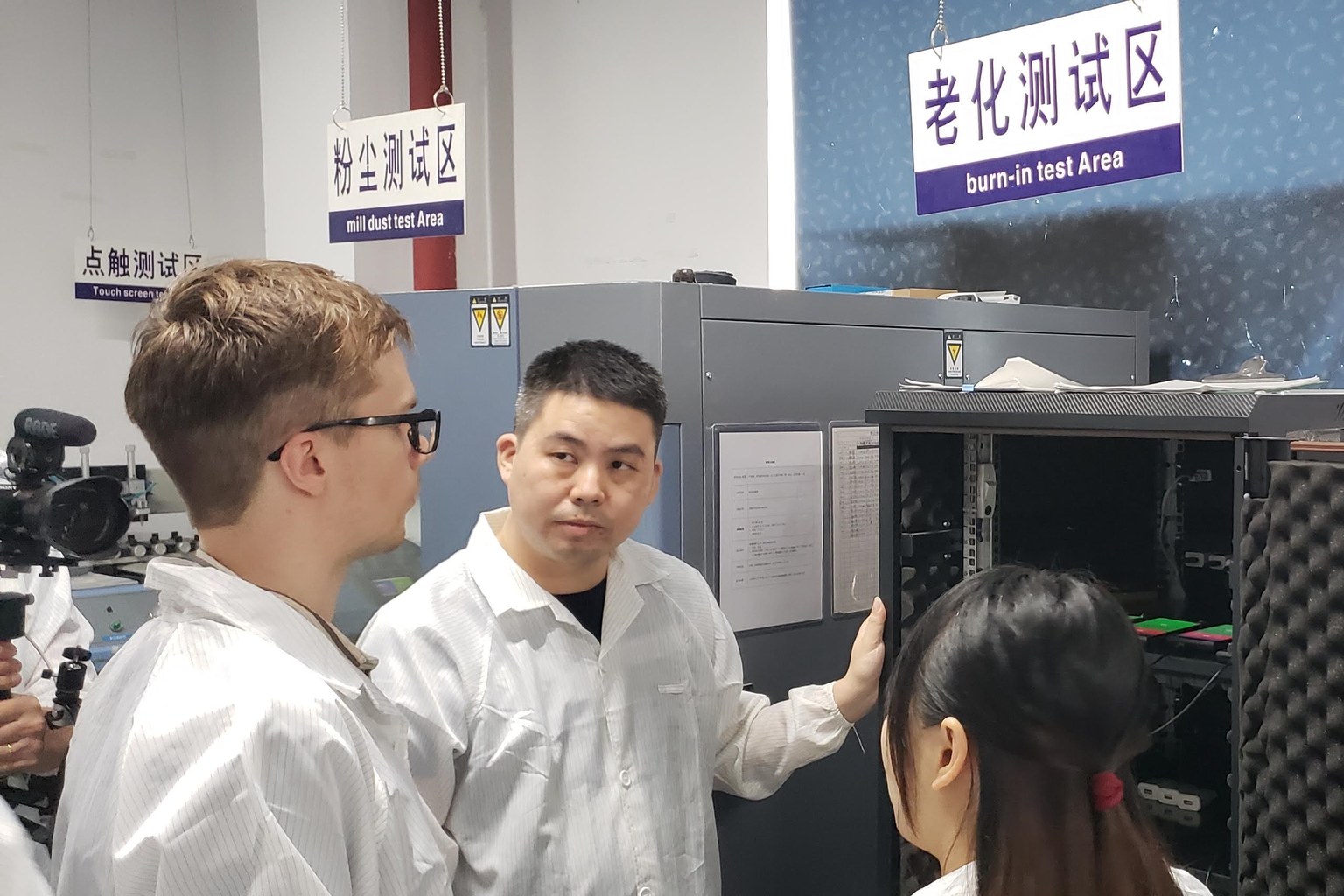
Every factory has a test station, and the test station is the factory's own instrument. That is not a reason to distrust it; it is a reason to read what it recorded. Ask for the test log for the lot: unit serial or carton number, result, timestamp, and the firmware version the bench was running. A file with 2,000 rows and no gaps is evidence. A line in the report that says "100% function tested" is a sentence.
Firmware is the check that gets missed. Benches often run a debug build with logging enabled, because the engineers were chasing something the week before. The production build that ships is different, and occasionally it is different in a way that breaks the pairing sequence. Test 5 units from the last carton of the run and read the version string in the companion app. If it does not match what you approved, the order is not finished, however good the units feel.
Then test the things the bench does not: pair two units, walk 10 m away with a wall between you and the phone, and listen. Radio problems do not show up as dead units. They show up as dropouts at 8 m that nobody notices in a 2 m test bay. On open-ear and bone-conduction products, put them on a real head, at a normal volume, and check for the rattle that a fixture never reproduces. The sampling arithmetic behind how many units you test is settled before you travel; what you test them for is settled on the floor.
Check 6 — Open a carton and pack it back
This is the check that finds the expensive mistakes, and it takes 45 minutes. Take one carton from each pallet position, open it, and lay the contents out the way the end customer will unpack them: outer carton, inner tray, accessory bag, manual, warranty card, sticker.
The most common finding is not a defect. It is the manual in the wrong language for the destination, or the EU importer's name and postal address missing from the carton and the insert, which the General Product Safety Regulation has required since December 2024. Both are 100% returns at the retailer's dock, and both are invisible in any test of the product itself.
Then pack it back exactly as it came, tape it, and look at it. A carton that bulges after repacking was over-filled at the line. A carton whose lid no longer sits flat had its inner tray compressed by the stack above it. Neither will be visible in a photograph of a pallet, and both will be visible on a shelf.
Check 7 — Drop a carton yourself
You do not need a laboratory to know whether a carton survives. You need a concrete floor, a tape measure and 30 minutes. The reference is ISTA 1A, which is deliberately simple: 10 drops — one on the most vulnerable corner, one on each of the three edges radiating from that corner, then one on each of the six faces.
The height is set by the packed weight, and getting it wrong makes the test either meaningless or unfair.
| Packed carton weight | ISTA 1A drop height | Typical product |
|---|---|---|
| Under 9.5 kg | 762 mm | TWS earbuds, smart rings, small speakers |
| 9.5 to 18.6 kg | 610 mm | Over-ear headphones in bulk cartons, mid-size speakers |
| 18.6 to 27.7 kg | 457 mm | Party speakers, multi-pack accessories |
| 27.7 to 45.4 kg | 305 mm | Dense electronics, power banks in bulk |
| 45.4 to 68 kg | 203 mm | Heavy single units, subwoofers |
If you only have time for a shortened version, do three drops: the vulnerable corner, the bottom face, and one long edge. That is enough to find the two failures that matter on consumer audio. The first is corner crush that transfers into the inner tray, which you can see by opening the carton immediately after the drop. The second is a split seam along the bottom, which usually means the tape pattern was specified for a lighter carton.
Pass and fail are worth agreeing in advance, because the argument always happens at the carton. A dented corner flute is normal handling and passes. A split corner seam, a puncture, a collapsed inner tray, a rattle when you shake it, or a unit that no longer powers on is a fail. Write those five lines into the annex and the conversation on the floor becomes a reading rather than a negotiation.

Check 8 — The battery paperwork, which stops the container and not the report
A shipment can pass every physical check on this list and still not move. On anything with a lithium cell, the constraint is documentation, and it is checked by the forwarder and the airline, not by the inspector.
The UN38.3 test summary. Not the test report — the summary. It is a one-page document with ten required items: the cell or battery manufacturer, their contact details, the test laboratory and its contact details, the unique test report number, the date of the report, a description of the cell including mass and watt-hour rating, the list of tests with pass or fail, a reference to the assembled-battery requirements, the edition of the manual used, and the name and title of the responsible person. A factory that sends a photo of a certificate instead has not sent this.
State of charge. Lithium-ion cells and batteries shipped on their own by air are limited to 30% of rated capacity under packing instruction 965. A factory that charges to 60% because the unboxing feels better will have the shipment refused at the airport, and discharging 24,000 units takes days. Say the number in the order, in writing, with the destination mode of transport next to it.
The rest of the file. The safety data sheet, and the air transport condition report from a recognised testing body — these are separate documents from UN38.3 and each is asked for by a different party. By sea the paperwork changes and the dangerous goods declaration replaces the air documents, but the weight still has to be declared: a 40 ft high cube carries about 76.4 m³ and up to 26,500 kg of payload, and the verified gross mass has to be filed before the box goes on the ship.
Five o'clock: what to write down, and what not to sign
The last 30 minutes decide whether the day changed anything.
Do not sign the report on the floor. Take the defect log with you, and count it against the acceptance number yourself — the log, not the verdict page, is where the answer is. If the log shows 7 defectives against an acceptance number of 7 on a 125-piece sample, the report says pass and the lot is on the edge of what you agreed to accept. That is a decision for you, not for the inspector.
If something failed, put the hold in writing the same day: purchase order, lot, carton numbers affected, defect class, count, and what has to happen before the balance moves. A hold that exists only in a conversation is a hold that evaporates on the flight home.
Photograph the defects properly while you are still there. Each photo should contain the carton number, a scale reference, and the defect. A close-up of a scratch with nothing beside it for size is a picture, not evidence.
And if the factory sorts and re-seals the lot after you leave, the report now describes goods that no longer exist. Rework is a trigger for a second inspection, not a favour to ask for later. That single sentence, written into the purchase order, is worth more than a longer checklist. It also only works if the plant can hold the quality in the first place, which is the question a factory audit answers before the first order rather than after it.
If you cannot be there, run it on video
Most buyers cannot attend, and the substitutes usually fail because they are a tour rather than an inspection. A 45-minute live call, unedited, can cover six of the eight checks above if you ask for the right things.
Ask for specific cartons — "carton 7 from the pallet against the back wall" — because a factory that has prepared for the call will hand you the carton it chose. Put the scale in frame with the carton on it, and read the number out loud so it is on the recording. Scan the barcode on camera with your own scanner app, not theirs. Run the shortened drop test in one take, from a measured height with the tape measure visible. Then walk to the packing line, without cutting, and show the tape, the labels and the pallet wrap, which are the three things a report never photographs.
Keep the video. If a dispute starts eight weeks later, a 45-minute recording with a carton number and a scale in it settles more arguments than any document in the file.
What we do on our own orders
The fair test of a checklist is what happens when it produces an inconvenient answer.
On a first order we run the carton count and the weights before anyone opens a box, and we photograph the pallet as it stands, because the pallet is the only part of the shipment that cannot be re-made after the fact. We drop a carton on the first production run of every new packaging spec, not only on the first order — packaging changes quietly when a supplier of cartons changes. And the defect log goes to the buyer before the balance is released, with the photographs, not the verdict page.
The habit worth borrowing whatever supplier you use: ask what happened to the units that failed. A factory that can tell you the defect, the count, the cause and the fix has a process. A factory that says there were none has a report.
Want the carton count and the drop test before the balance is due?
Tell us the product, the destination market and the packaging spec. You will get the pallet photographs, the carton weights, the barcode scan result and the drop test outcome with the carton numbers — before the balance moves, not after the container is loaded.
See how we run an OEM programme →